Monday, March 31, 2014

Elite Beat Agents and the Meaning of Passion


Video game concept: A group of snappily-dressed gentlemen travel the globe and inspire regular people by dancing to popular music. Hope and motivation would be in short supply if not for these suit-wearing male cheerleaders.

If you're wondering what such a game would be like, look no further than Elite Beat Agents for the Nintendo DS. This game absolutely took the handheld scene by storm during its release and people I know are still making references to this game. Just like in the paragraph above, the game is about the titular agents as they travel the world and spread passion to the people. How do they do it? By acting as cheerleaders singing and dancing to popular music.

As you can tell by now, Elite Beat Agents is set in a modern world of cartoon fantasy. And even though the game revolves around the agents, the stars really are the people that the agents inspire. These aren't your typical video game problem-solvers. Instead of saving the world, our protagonists have more relatable goals and issues such as babysitting, creating art, proving their worth or just trying to survive in a rough-and-tumble culture.

Some typical gameplay. The player is following the beach ball left to right and afterward going to tap the 2 and 3 buttons

Instead of saving the day behind the scenes, the Elite Beat Agents are all about filling their targets with the courage and passion they need to do it themselves. This being a game, simple problems quickly turn into wild adventures. But the themes of overcoming doubt in one's abilities are still there. Let's quickly go over how this game is played.

For the uninitiated, Elite Beat Agents is a rhythm game that tasks the player to tap buttons on the DS touch screen following the melodies of well-known songs. These buttons fade into the screen and have circles closing in on them, indicating the right time to tap. In some cases, the button then prompts the player to follow a path on the screen, or some other follow-up motion. The result is a whole routine of button-pressing that compliments the song perfectly. As the song goes on, there is a status bar on the top of the screen that goes down. Should it empty entirely, the stage is lost and the player has to try again. This bar is bumped back up by the player performing the song well. This gameplay does very well to excite and push the player to do well and earn a good ending.

On the note of endings and stories, Elite Beat Agents has some of the most energetic presentation I have ever seen in a game. It's rife with passion, over-exaggeration, endearing charm, great characters, excellent themes, and is just a pleasure to experience the whole way through. Let's take a look at one of the game's stages.


The "Makes No Difference" stage - Interesting because the outcomes rely on the lead actor, which relies on Chris's directing

Stage 2 of the game introduces us to director Chris Silverscreen as he works hard to produce the next great blockbuster hit. Morale drops when one of Chris's bosses comes onsite to tell him that his job is strictly on the line. Chris carries on, but the extra weight is dragging him down. Chris's self-doubt and stress pile up, culminating in the desperate cry of "HEEEAAALP!" Thus, the Elite Beat Agents embark to motivate Silverscreen and make "Romancing Meowzilla" a huge hit!

I really must stress the significance of the "HEEEAAALP!" screams in Elite Beat Agents. It's the call that summons the agents to the target's aide, but it means so much more. The emotion that drives every character to yell this call is a very relatable one. Even though the situations are different, the emotions are the same: Self-doubt, anxiety, stress, maybe even helplessness. In short, the nagging voice that says "I can't do this. This is way bigger than I am." I am absolutely sure every person has felt this at some point. Perhaps some among us are feeling it right now. And I can assure you many of us will feel it more times in the future. Thus, I am certain we can all relate to feeling this emotion, especially to the point where we would shout "HEEEAAALP!" if it meant receiving any degree of help.

You can see the magic of the agents right away when they lift Chris straight out of his funk and get him waving with the music. After all, the best start to a daunting task is to loosen up. A little bit of waving with the music to take his mind off of the stress of the task will only help. You may also interpret this as him "riding the wave" of positive thinking and progress. This will be more significant in a few paragraphs.

Here you can finally see the game in action. All gameplay is reserved for the bottom screen while the top screen shows Chris as he works toward producing his movie. On the bottom screen, the  buttons appear to the beat of the music and you will gain points for tapping and dragging, depending on your reflexes and timing. Your performance not only affects the meter that you keep above failing levels, but it also affects how the events on the top screen play out. Performing the gameplay well will depict Chris as making progress. Performing poorly will depict Chris as struggling or failing to reach his goal. Performing perfectly will depict Chris succeeding greatly and with infectious gusto.

I find this very well represents what it's like to progress through a daunting task. You'll have your highs and your lows, and moments when you're just coasting through with moderate progress. In fact, depending on your task, you may coasting much of the time.

More sample gameplay. The circles around the buttons close in and when they overlap with the border of the button, that is when the player must tap.

The music you're hearing is a cover of Sum 41's "It Makes No Difference." And I must say, Elite Beat Agents has one of the most memorable soundtracks not necessarily because the songs on it are all original and of great quality - in fact, the entire core soundtrack are all covers of popular music. What makes the songs stand out is the context that they are used. In this game, music and gameplay are intertwined. The routine of button-pressing is set to the music, so you become intimately familiar with the music out of necessity for playing the game well. I find that this set-up has given me a fondness for all of the songs in the game's soundtrack. It helps that when you perform well, these songs are the background themes for your awesomeness. You can see comments all over the Internet from people who have a problem with popular music saying that this game makes it enjoyable.

You'll notice that in this game, stages take place in typically four sets. At the end of each set, depending on if your meter is above or below 50%, an event occurs that shows if your protagonist succeeds at the immediate task. In the case of this stage, we see if Chris's directing pays off and his lead actor pulls off the performance of a lifetime. In this stage and any other, seeing these little victories along the way to completing the stage is very rewarding. Remember that quivering ball of doubt that your character was at the beginning of the stage? Well look at what they're doing now!

Between sets, we return to seeing our character doing the wave, but as the stage progresses we see more characters joining in. I love this aspect of the game, since in my eyes it signifies the point when those characters are "on the same wavelength" as our protagonist, so to speak. It's one thing for Chris's lead actor to do his job, but it's another for him to really understand Chris's passion and motivation. With the lead actor joining Chris in the wave, I feel like he's really on board and sharing in that passion to make a great movie. Later on, even the antagonistic executive joins the wave, which goes to show even the bad guys in these stories see things more the protagonists' ways. To be fair, the executive does soften up when he sees the progress made in the movie.

The ending you get for a stage is based on how many sets you passed. The best ending is if you pass every set, there's  a neutral ending if you miss any sets, a bad-ish ending if you miss all the sets but still pass the song, and running out meter entirely will "reward" you with a soul-crushing failure scene. Trust me, these are hard to watch. In Silverscreen's case, all of his efforts and directing prowess pay off. "Romancing Meowzilla" is a huge hit, he makes his bosses happy, he keeps his job and can keep doing what he loves.

For me, what's more rewarding than winning in this game is seeing the evolution of its characters as the stages progress. They go from self-doubt to unflinching confidence - which you may notice is signified with a very distinguishable face bearing sharp half-circle eyes like masked superheroes - something that I refer to as the "fervor face." It's the face of a person who is well past the point of "Can I do it?" and only focused on where and how to make it happen. I love it.


The "Sk8er Boi" stage - A prime example of the protagonist using the fervor face

The next stage places us in the backseat of Jack, an ace taxi driver. He's good at his job, but he has a problem driving too fast. After being let off with a "friendly" warning from a police officer, a woman in labor barges into his car and tells him to step on it for the hospital. Jack can't risk being caught speeding again, but time is of the essence. With nothing else to do, Jack starts his engine and makes for the hospital with a shout of "HEEEAAALP!"

As we can gather, most - if not all - of the cries for help are not so much "This is out of my league, please help me out of this responsibility" but more "I'm going in to make this happen! Back me up!" For characters like directors and taxi drivers that are normally mundane in video games, this is a great attitude. The music for Jack's stage is Avril Lavigne's Sk8er Boi. The fun part about this song is how it tells a story, thus the lyrics are prevalent and clear. Even though the lyrics don't have much to do directly with the events of the stage, I still feel there is some connection. Perhaps because the pace of the song's story arc matches the stage's pace and there's some synergy when both stories are at their climax.


The "YMCA" stage - Look at this man tear through his plight

Another of the game's stages which makes great use of lyrics is the game's seventh stage, in which we join the quest of a sailor out to find treasure. The song for this endeavor is the time-tested and iconic YMCA, credited as being covered by TC Moses. And I must give props to TC Moses because regardless of if this song sounds like the original or not, the version we have in Elite Beat Agents is every bit as fun and energetic. I know I would be down to explore the depths of the ocean to such a tune. I can't tell you how pumped I was just hearing the initial horns and drum beat.

The "Anthem" stage - The story of a wash-up who hasn't given up on himself

The last stage I want to mention is the game's fourteenth stage, featuring an allegedly washed-up baseball player, Hulk. He had his run in the big leagues and struck out in more ways than one. He lives a life downtrodden melancholy until one day when the amusement park he works at is under attack from a volcano monster. It's up to Hulk to save the park from destruction using weaponized baseball skills! Of course, this story isn't as down-to-earth as the rest, but the themes are possibly deeper. Hulk has already seen the worst brunt of failure and yet puts in the effort to save the park and his biggest fan who is caught in the action. To me, that makes Hulk's story powerful in its own right. Rather than avoiding failure at all costs, he is overcoming the current paralyzing effects that a past failure can have on a person.

In the end, the power of music may get our protagonists up and doing, but it is the power of passion that makes everything possible. Behind every character and story is some sort of passion or drive. The same can be said of anyone. Every person has something they're interested in, and if we could we would pursue those interests with our hearts and souls fully invested. However, many of us don't pursue these interests for a variety of reasons. Either we don't find them practical as a living, we believe we don't have what it takes to make a living of it, or we just turned to the more practical occupations to place all our effort. And in some cases, the more practical occupations are our passions and we're as happy as can be. In any case, we all have something we want to do and do it well, and in a perfect world, we would all be masters of our trade. And to all of the masters of their trade currently reading this article, I commend you.

In Elite Beat Agents, antagonists take the forms of executives, traffic cops, aliens, unruly children, and the weather itself. But the real conflict throughout the entire game is people versus themselves. Every character is perfectly capable, but the only thing stopping them is their own self-doubt. Once they get that confidence, the problem doesn't stand a chance. It's in this way that we might even think of the agents themselves as purely symbolic. It's incredible to think all these people can gather the courage by themselves, but more comforting and empowering to think that we all have this group of agents somewhere in the distance confident enough in our ability to cheer us on by dancing to popular music.


The first stage of "Osu! Tatake! Ouendan" - The simple story of a student needing to study for exams

And I can't end this article without talking about Ouendan. Many people in the gaming community already know about Ouendan, so they can skip to the next paragraph while I clue the rest of us in. "Ouendan" is the colloquial name for "Osu! Tatakae! Ouendan" the Japan-only game to which Elite Beat Agents is an international "sequel" of sorts. I'm no expert, but I'll explain this as best I can with my limited knowledge and research: An Ouendan (spelling may vary) is a Japanese cheer squad not unlike cheerleaders in function. Though whereas cheerleaders rally up support by having a good time, the typical Ouendan will instead deliver an intense, stoic performance. I imagine it's because they take belief and inner strength very seriously. Thus they project such a professional tone to help their team's resolve sturdy up as well.

The Ouendan game very much takes a stoic approach to passion and motivation. Compared to the Elite Beat Agents, the Ouendan members are serious. Not mean or disagreeable, just very intense and focused on their task of bringing drive to the people. Instead of doing the wave, character in Ouendan put on their fervor faces back with the flames of passion. I guess you can say the attitude in Elite Beat Agents is "Take it easy, you've got this" and the attitude in Ouendan is "You are so capable of overcoming this challenge that it is your solemn duty to do so!" Personally, I can see how the stoic approach well represents Japan while the laid back approach powered by popular music appeals much more to the general international audience.

Different though their methods may be, Elite Beat Agents and Ouendan both set out to celebrate the common person and to me they succeed. Every profession, hobby, and undertaking in these games are shown in an impressive light. And you know what, in the right light, that applies to us in real life as well. Anyone can truly seize life if they keep their passions front and center in their minds and in their hearts.

We can't discount the power of music, either. With my playlist open as I type, I can vouch it helps. How about you? What music do you listen to that gets you in the mood for what you love? Perhaps the next time you listen to it, you can imagine a squad of agents dancing to it in the distance.

But before we sign off entirely, let's cut some onions

Thursday, November 21, 2013

Dark Cloud 2 and Zealotry


Ah, Dark Cloud. This series has been on the sidelines of gaming culture since the days of the PlayStation 2. Far too long in my opinion! My passion for the series was recently reignited when I came into contact with a fellow video maker and I saw he has Dark Cloud videos on his channel. All of this remembering Dark Cloud reminded me of a story I want to share with you all!

For the uninitiated, Dark Cloud is a series of action/adventure games where the player takes control of a number of characters on a quest to save the world. Part of saving the world requires the player's party to venture into multi-floored dungeons as part of the storyline. The second game in the series differed from the first by featuring only two playable characters. But it made the most of those characters! Max, an inventor, is able to jump in a giant robot to completely whoop on enemies. Monica, a magic-using princess, is able to transform into monsters and use their abilities. And there is where my story begins.

At one point in the game, the player needs an item called the "Sundrop" in order to progress. The only way to get a Sundrop? Transform into the "Himarra" monster and talk to a Himarra. That's right, while your character is transformed into a monster, she won't be attacked by monsters of a similar type. You can even talk to your fellow monster as if they were a friendly non-player character. When you obtain the Sundrop, you even hear the Himarra's voice! I don't know about you all, but I got attached to the Himarra I talked to. Did I mention that you can just pick any Himarra wandering around the dungeon? That's right, the game doesn't just give you a monster to talk to. You actually have to find one yourself. That made the mission all the more personal to me.

This is a Himarra. Isn't it adorable?

That's why I was shocked at what happened next. After obtaining the Sundrop, I naturally thought "No reason to stay as a monster anymore," and transformed back into Monica. Imagine my surprise when the Himarra I was talking to moments before starts attacking me! "What's going on?" I thought. I pleaded to the screen, "Why are you doing this? It's me! We were talking a minute ago! You helped me!" but the Himarra would not - or could not - listen.

Eventually, I had to act. Putting on my best action movie drama face, I muttered, "Don't make me do this." But I had to. I forced Monica to cut down this monster that she had been fraternizing with moments before. Monica herself didn't even flinch to destroy the monster. She acted with the same neutral conviction that the monster had. I alone harbored this connection that didn't even involve me.

Okay, perhaps I'm embellishing the drama of this anecdote. A little. Especially considering I know why things turned out the way they did. In reality, the monster was nothing more than a construct of a game. It was a set of pixels on the screen programmed to behave in certain ways under certain circumstances. In this case, the monster was programmed to be hostile to the player unless the player assumes the form of a similar creature. In no capacity is the monster able to observe, learn, think, and defy its original programming. There's just no need for that in the game.

And yet, I still reacted this way. Who am I to be feeling this way, anyway? If this mission didn't even exist in the game, I wouldn't have second-guessed chopping down that Himarra in the first place. And that certainly didn't change anything afterward. What is it about connecting with that one video game enemy that's getting me to think so hard? I dove into the very core of the human condition to find an answer and I have come up with something.


At 14:45 you see the player get a Sundrop from a Himarra

You see, I humored the idea of the Himarra as a free-thinking being and went from there. The question then became why the Himarra would choose to attack me as soon as I presented myself as a non-Himarra creature. And, well, perhaps I'm not giving Dark Cloud 2 enough credit. What I'm chalking up to game mechanics may, in fact, be something more complex and tragic.

Where I'm more open to friendship, the Himarra may be more discriminating. After all, it lives in the wild where survival instincts take hold. The Himarra knows it can trust its own kind and probably has experience that tells it that there is no such guarantee with other types of creatures. Thus it stands to reason that when I transformed back into a human, the Himarra had a logical negative reaction. It could have thought that I was a spy amongst its ranks, or, even more heart breaking, it could have felt a sense of betrayal at seeing this new friend lie about who they are. Heck, this Himarra probably knows that humans are the most dangerous, destroying monsters left and right with ease. With this logic, the choice to attack as a pre-emptive defense is understandably obvious.

I got a little scared thinking this way. In a matter of seconds I took a course of action that was based on false assumptions, but phrased it in such a way that anyone would agree it was the right thing to do given the circumstances. I'm even more scared now because I am all too familiar with that way of thinking.

Attack-on-sight mentality of very common in our world, both in instinct-driven creatures and deep-thinking individuals. You do have the people who use pride in their identities to strengthen their roots and improve their character, but history shows conflict is in the blood of any culture and "us versus them" has been a time-tested mantra for unifying people, albeit of specific ideologies, for better and worse.

I remember when the first Dark Cloud was called a "Zelda-Killer." At least it gave us this great art!

Showing hostility as a roundabout way of showing support makes sense from a passion standpoint, but is flawed and stunts a person's growth as a cultured and free-thinking individual. For instance, I remember when Harry Potter was in full swing and I saw a news report on the series' exploding popularity. One interviewed mother said that she didn't care about Harry Potter nor will she bother reading it. The reason? Her family were already fans of A Series of Unfortunate Events and she resented Harry Potter for taking the thunder of her preferred series. Whether you prefer either book series, imagine that. A person willing to turn away from something new just because it was more popular than what she already knew.

There is a word for this sort of uncompromising conviction: Zealotry. Don't get me wrong, one can be a zealot for good causes and work their zealotry for the betterment of the world. But in general, I feel there's something uncanny about being too sure of yourself. This comes from personal  experience. Throughout my life I've found groups I can identify with and do well to fit in until I was expected to join in on badmouthing other groups or ways of thinking.

For instance, I talk to people all the time about watching what I eat. I do believe that a good life includes indulgence, and at the same time I'm still open to new things and trying the "less is more" approach to eating right. A few people I talk to, however, are deeply entrenched in one or the other and are very passionate about playing down the other half. I'll tell a calorie-cutting friend that I really enjoyed a meal out with a group last night and be told in return that I should stop letting my company coerce me into unhealthy eating habits. On the other side, I'll try getting water with a meal instead of soda to see how much I really miss it. Seeing this, my more wining-and-dining friends will tell me I'm acting like one of "them." I assume "them" refers to the insufferable sort of fitness enthusiasts who often go on record condemning common eating habits. Even if my friends don't mean to tear down the other side, their word choice still reflects that sort of mindset.

Without staying specific to one group, you can still see where I'm coming from. People can love what they love, but when they try to love through hate, that's going a bit far for me. If it gets to the point where someone could say "You're one of THEM," for any reason, then we're no better than the Himarra who's only following his programming.

I planned on putting in video game zealotry, but my search turned up nice consoles so I'm going with that instead. Found here. I really want to credit the source.

We're going leave this off on a community note. Let's share our own zealotries and see how or identities shape us. As for me, anyone can tell I'm zealous about video games and further the study of video games as a serious cultural medium. I may not agree when it comes to all criticism of video games, but only because I prefer to talk things out. Behind every piece of criticism is a story and a topic to explore further. If we just take the criticism at face value, that's no good. How about you? What are you zealous about? Games, movies, sports, comics, food, exercise, or even your work?

Thank you for reading, and I look forward to reading about how diverse this audience is!

-

Email: RBAshkenazi@gmail.com
deviantART: http://captain-gamer.deviantart.com/
ScrewAttack: http://www.screwattack.com/user/captain-gamer
Tumblr: http://captaingamer.tumblr.com/
Twitter: https://twitter.com/Captain_Gamer
YouTube: http://www.youtube.com/user/GamerHangVideos

Wednesday, November 13, 2013

Wii Fit and a Spoonful of Sugar


It is the middle of November and by now people all over the world are exercising to their trial versions of Wii Fit U. I am one of them, which is good since I fell out from being consistent with the first Wii Fit. But I'm back on the Balance Board and things are looking up! I have already partaken in many of Wii Fit U's games and I am having actual real fun! And that fun is pivotal to today's topic.

"Wii Fit" is a household name to many, but for the uninitiated, Wii Fit is a game that gets the player to exercise. Since the game cannot provide physical feedback like standard exercise machines, it instead provides instructions and challenges that require the player to pose and move around in certain ways. For instance, Yoga exercises in a Wii Fit game show the player how to adopt a given Yoga position, then assess the player's ability based solely on how able he or she is able to maintain their balance on the Wii Balance Board. I could choose not to do the pose and stand comfortably so that the game would give me a favorable rating, but beating a video game wasn't exactly on my mind when I chose to buy Wii Fit.

Wii Fit U offers many yoga exercises, strength exercises, dance steps, balance games, and more, but what really got me inspired writing was my first experience with Wii Fit U's "Free Step" exercise. The activity is a simple one 1) Step on to the Wii Balance Board with one foot while raising the opposite arm and moving the other arm back. 2) Step on to the Wii Balance Board with the other foot while returning your arms to a neutral position. 3) Step off the Wii Balance Board with the first foot, this time raising the same-side arm and moving the opposite arm back. 4) Step off the Wii Balance Board with the second foot, returning your arms to a neutral position. It takes some getting used to, but Free Step gives you plenty of time to adjust. How much? Oh, in the area of a half-hour.

This deceptively simple screen has everything you need to step like a pro

If that last bit made you say "What!?" let me tell you my reaction was very much the same. When you start Free Step, you are given the option to quit at any time. You are also given the goal of completing over 2000 steps within that time. The game can work off of the Wii U's Gamepad so that your TV can be freed up for other things while you step through your half hour. Since my first playthrough of Wii Fit U was intended to just be a trial run to see what the game had to offer, I figured I'd do a good 100 steps and call it to see what else I could do.

So, I was off. The screen displayed a stage where my character and a bunch of my handmade Mii characters had their own Balance Boards. The onscreen character automatically did his steps, which was my prompt to imitate him to make sure I'm doing it correctly. The game even provides a helpful stepping sound effect to signal the moment when your moving foot should touch down each time. I took all of these into account and began my steps. The game only counts steps you actually do, and uses pressure on the Balance Board to verify those steps.

As I worked to imitate my character as close as possible, stay in step, and switch feet as smoothly as he did, 100 steps came and went. I don't know what it was, the step counter, the little Miis standing around supportive, the trainer's voice informing me of my progress, or just how little I looked at the ingame timer counting down from thirty minutes, but I was feeling pretty good. The steps weren't physically demanding at all, but I was still working up a good amount of effort. I was also getting bored, but in the best way. I got the idea of what to do and the steps were too slow. I then noticed that Free Step has three tempo settings and I had been stepping to the lowest one. It was time to get Wii Fit! I clicked onto the second setting, found it alright, then clicked onto the third setting. And then I was off for real.

As the minutes ticked down, the steps ticked up. With four steps in a cycle, it was 25 cycles for every 100 steps. At some point, the trainer even stops using specific numbers when telling you how many steps you've done. That's a good indication of when you're high up there! Over the half hour, I could move in tandem with my Mii on the screen and switch feet on the fly seamlessly. Pretty soon I was looking at the clock, but only to get an impression of how many more steps I could get out before the half hour was up. I was in a state of Zen that I was in no rush to leave. And yet, all good things come to an end. When the half hour was up, I had done well over 2600 steps and could feel them all in my thighs. And I still went for another 15 minutes on other games to round out the full hour of exercise.


Some of these games take crazy coordination. I love his enthusiasm!

Now, I consider myself middling at best when it comes to work ethic for exercise. Yet here I was putting in half an hour straight of steps. What happened? My friends, gaming happened. It's easy to feel negative about exercise if you haven't done it in a while, but it's even easier to feel positive about games, especially if you haven't played any in a while. Wii Fit U managed to take the eagerness I normally reserve for games and redirect it towards exercise. Whatever associations may be keeping me from exercising were rendered null in the face of my overwhelming love for games. You might say that the game "tricked" me into exercising, but I certainly don't feel tricked. And if it is fact that I was tricked, that's my kind of trick!

This experience taught me the importance of associations in human psychology. We as people can have very warped senses of priority based on previous experiences. This is where procrastination comes from, after all. I hear all the time about workers who have a report due the next day and they'll play five lives in Candy Crush before even looking at said report. It's not even a contest. It's also easy to understand how that happens. Candy Crush is fun, colorful, and gratifying. Comparatively, the report is arduous. Imagine if the worker could channel that eagerness from Candy Crush to that report. After all, that individual report needs to only be written once while Candy Crush will always be there.

And that's basically what happened with me on the Wii Fit U. I can't speak for everyone using the software, but I have gone on to incorporate more activities in my usual exercise routine and be more consistent with it. I may not have the benefit of a game tracking my progress, but the positive experiences I had with exercising filled in those gaps. I less thought about exercise as something strenuous and more like a cumulative activity that I am meant to improve and build on. Even if it were scientifically proven that exercise shouldn't be possible and fun, I am able to keep doing it as if it were. Thus, I was "tricked" not only into doing exercise, but enjoying it as well.

Two saying passes through my mind in response to this. One was "Give a man a fish and you feed him for a day. Teach a man to fish and you feed him for a lifetime." The other one was "A Spoonful of sugar helps the medicine go down." Though the first one is relevant, I believe my case with Wii Fit is more accurately described by the other. Many will recognize this quote as sung by Mary Poppins to motivate the Banks kids into cleaning up. Literally, the quote refers to the general bitterness of medicine and a child's unwillingness to take it, even if sick. But adding a spoonful of sugar will make the medicine taste appealing enough for the child to take. In context, Poppins is saying that menial tasks can be completed quickly and made fun if you don't think of them as menial and more gamelike. Sure, the film depicts "fun chores" as simply snapping one's fingers and watching the room clean itself, but clearly that is symbolic for how easy it is to clean one's room when you're having fun while doing it. At least that's how I choose to see it. And I digress.

Ms. Poppins explains it best herself

I would encourage official study into this topic of enriching non-game work ethic with game-like incentives, but that actually has been well underway for years. Many of you probably have been thinking the term "gamification" throughout this whole article, and you'll all be right. For a quick reference to what gamification is, I point you towards this early Extra Credits episode on the topic. Very good viewing. And as you can see from the video, gamification is still very early in its development and has incredible potential for growth, but it still represents everything I've been talking about throughout this article. In fact, you could say everything I've been writing about since March is a case-by-case argument for gamification's potential.

How about you? What experiences have you had with motivation in video games? What are some times where game-like thinking have helped push you along, or even been key to solving a problem? I have found that when I go into a game, I come into it with a sort of neutral optimism because I know the game was designed with my success in mind. This is an attitude that video games do in a way all to their own. I'm not even aware of this positive attitude, but I have brought it with me to non-game situations and been all the better for it. I'll bet every gamer also does this and has a great story from it.

Thank you for reading, and I'll see you in the Wii Fit U Gym Communities!

-

Email: RBAshkenazi@gmail.com
deviantART: http://captain-gamer.deviantart.com/
ScrewAttack: http://www.screwattack.com/user/captain-gamer
Tumblr: http://captaingamer.tumblr.com/
Twitter: https://twitter.com/Captain_Gamer
YouTube: http://www.youtube.com/user/GamerHangVideos

Thursday, August 1, 2013

Phoenix Wright and Focus


By now, my Nintendo 3DS is my preferred exercise companion on the treadmill. Sure, other devices offer similar services, but nothing captures my attention like a good Pokemon battle, RPG cutscene, flight around Wuhu Island, or courtroom drama. For today's topic, we will discuss why that last example is so effective.

We all can agree that the Phoenix Wright games really make us think. Capcom's law games create these little worlds of scenarios, character, evidence, and motivations. At its most intense, I have found myself so immersed in a Phoenix Wright storyline that I began seeing the real world in terms of alibis and some way in which a murder could have been hidden.

Officially known as the "Ace Attorney" series, some games in the franchise even star other characters and take place at various times in the world's history. Phoenix Wright just happens to be the most recognizable aspect of the series .

For the uninitiated, Ace Attorney games work your problem-solving skills more than they do your reflexes. You won't be defeating enemies one after the other, nor won't you be grinding up stats, picking up loot, earning weapons, or even much of controlling your characters. The bulk of Ace Attorney gameplay is in its dialogue. You will spend more time hearing characters talk and explain things than you will taking any sort of action.

Everything happens in menus, and every option opens up a colorful and endearing new event

On paper, this sounds dreadfully boring. But in execution, this is perhaps the most enthralling way to play a video game that I have yet experienced. Like I said above, an Ace Attorney game is more than interactive media. It is a window into a world of intrigue and murder mystery. And yes, every court case boils down to murder at some point.

Every chapter follows the same formula: Your main character meets a person who is charged with murder and takes the case to defend this person. From there, you hit the streets to scour the crime scene, find evidence, and talk to people related to the incident. The games are all very linear, so you'll be following a carefully crafted storyline the whole way through. When your investigation is over, it's time to head to court where you will engage in debate with the prosecutor, whose job it is to see your defendant found guilty.

Already you can see how Ace Attorney can keep a person hooked. The gameplay and the storyline are chained at the hip. Whereas most of what happens in a video game is part of the "experience" and you can go for long stretches without continuing the story, Ace Attorney is in storyline mode full-tilt. If the game ever stops, it's because it needs you to nudge it in the right direction. You are never not ingrained in an Ace Attorney storyline for as long as you are playing it.

By now you're probably wondering what it is the player actually does which presents any challenge. Well, there come times in the story where your protagonist will have to put money to mouth and prove their point with some evidence. But they won't do it by themselves. When you hit that impasse, it's up to you, the player, to sift through the evidence and find that piece that will throw doubt on the other person's claims, forcing them to elaborate or admit to lying. So, if your witness claims to have never been at the crime scene and yet you found their phone right next to the body, time to raise an OBJECTION!! Digging up the truth is very rewarding, and watching your character pursue that line of logic further just makes it all the better.

 But allegedly, the victim wrote the defendant's name with his right hand. Curious...

Bringing it all together, what does this game being good have to do with me being on the treadmill? Nothing, directly. But it does help me focus on the exercise. And funny enough, it helps me focus by taking my mind all the exercise almost entirely. And let me say ahead of time that this is a particular sort of multitasking that not everybody can do, so be careful if you try it out.

First, by concentrating on the game I am less aware of my surroundings. Not by a whole lot, just enough to where I am not constantly checking the clock, calories, or distance. This way, I won't be thinking about how much further I need to go. Likewise, since I'm not focused on the strain of the exercise, I won't have any reason to exaggerate how tired I feel just to give myself a reason to cut it short.

Second, the attention that I am not giving to the exercise pours straight into the game. With the amount of attention that game commands, it's not likely to let go of that focus any time soon. The storyline is constantly in motion, so at any time you can just click on it to see more. Further, the conversations and characters are entertaining enough where pretty much any exchange contains at least one smirk or laugh out of the player. There is a lot going on at any time in the game, so you'll be thinking about the storyline and what the newest developments mean for the larger mystery afoot. Even putting the game down to think about something will keep you invested enough to where you won't get bored while exercising.


The game's music is also exceptional and has everything to do with the Ace Attorney experience. The iconic "Cornered" theme is catchy, especially in a capella.

There are two caveats for this method. First, playing a game while exercising requires being able to multitask in a very particular way. While I can stay enthralled in my game, I still need to keep up with the treadmill, maintain balance on the belt, and keep an eye on the timer so I can scale up the speed according to my routine. If you cannot multitask like this, then this whole method could prove dangerous. Practice first on low speeds, even if you already multitask well.

Second, there do come those times in an Ace Attorney game where you will get utterly stumped. The solution is out there, but your thought process won't find it. In those cases, the game's hold can wane. In that case, you may want to switch up for a game that doesn't require problem-solving to continue, like Animal Crossing.

These things aside, I have a great time on the treadmill with 3DS games, Ace Attorney in particular. If the story really picks up, I might even pull some overtime just to keep in the zone.

All of that said, I'd like to hear from you. What activities keep you in "the zone" like a good game does? Which activity would you like to have a zone for? A game-like perspective on that activity may help in accomplishing this. On the other side, what are good games you like to play while doing something else? And on the other side of the other side, what are some things you like to do while playing games? I know I like to wind down at the end of the day by catching up on my videos while playing some Borderlands 2 or Cube World. I look forward to seeing what you all have to say! Until then, game out.

Tuesday, April 23, 2013

Dead Space and Being the Silent Protagonist


I love the first Dead Space. By now, the Dead Space series has made a big name for itself and spanned three installments with some games and literature on the side. But before the brand took off, there was just the one really ambitious title. Dead Space has great atmosphere, looks incredible, employs creative enemy designs, and gives players a satisfying variety of weapons. It's also one of the definitive games that emerged from the boom of American-made horror titles in the late 2000s. Don't quote me on this, but I imagine the immense success of Capcom's Resident Evil 4 got that ball rolling.

There is one aspect of Dead Space that I think is vastly understated even today. Later installments even did away with this precedent that I thought was pretty important. I am of course talking about the fact that protagonist Isaac Clarke never spoke. Everyone else carried conversations naturally, but Isaac himself never got a spoken word in edgewise. The game covers for this by having all the conversations scripted in ways that don't require Isaac's input.

The silent protagonist in video games has been around since video games themselves. When the main character of a game lacks a voice, it becomes easier for the player to project themselves in the character's place to be more engaged in the game's settings and situations. Gamers most often think of iconic silent characters such as Crono, Gordon Freeman, Link, and other characters who never actually speak in written dialogue.


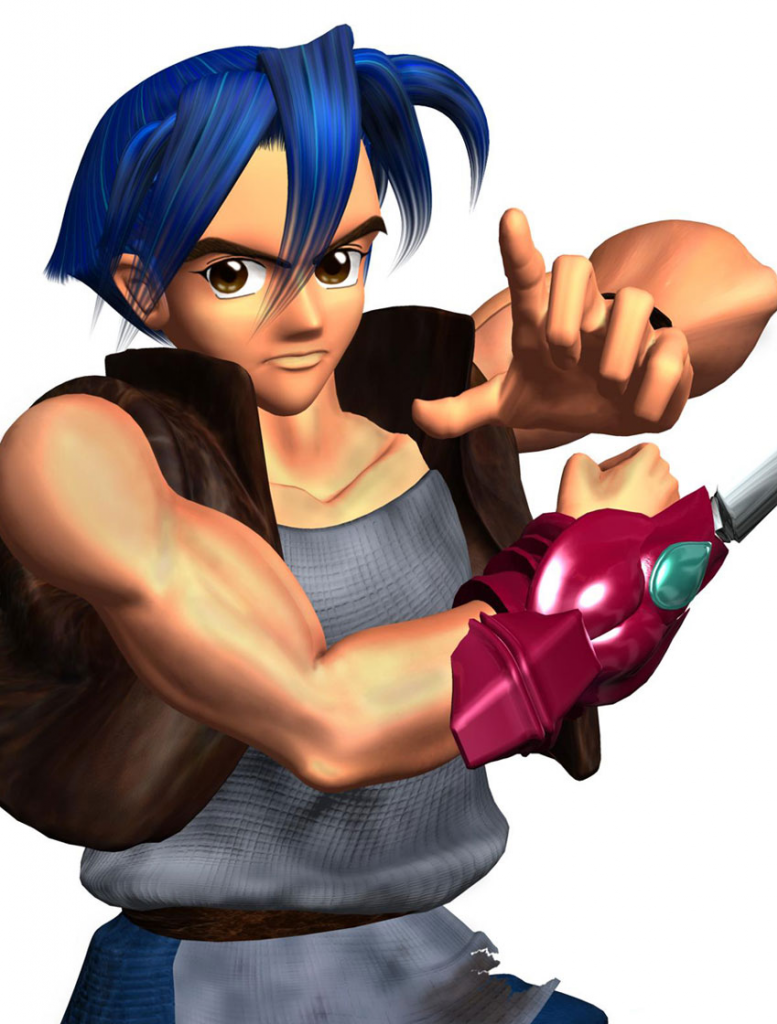
Vahn from Legend of Legaia is my obscure silent protagonist of choice

However, are these characters really silent? These silent characters clearly communicate through the course of their games. For instance, a character's dialogue with the main character will come off as a conversation with him or herself. "May I help you? Oh, you want the water gem? I can't give it to you unless you slay the dragon. You'll do it?" In Mario and Luigi: Superstar Saga, the plumbers have dedicated animations for when they speak. Even though their words come out as a string of comical gibberish, they clearly hold functional conversations with the other characters of the game world. There are games out there where the main characters don't communicate, but I feel this has the most impact in Dead Space.

Let's examine the situation: In Dead Space, Isaac is stranded in a derelict space vessel that is infested with horrifying monsters. He is not entirely alone since he maintains contact with two colleagues, Kendra and Hammond. While Isaac braves the depths of the USG Ishimura, Kendra and Hammond remain in relative safety while they figure out what's wrong with the ship and how to escape their predicament. For most of the game, everything Isaac does is not his idea. He simply moves from order to order issued to him by other people.

Further, the game is scripted and acted in a way that Isaac's silence just feels natural. The way the characters interact with him, you get the impression that they are used to carrying a conversation with Isaac. Instead of Isaac simply being slapped with the stigma of silence for effect, that may just be part of his character to be soft-spoken, if spoken at all. All of this, combined with the way he moves like a civilian, has Isaac strike me as an introvert. Quiet, maybe a little awkward, evasive but not reclusive, and generally a softer personality type than what Western media typically offers.


A great documentary going into the thought process of using a nonstandard hero.

Given this, your first impression of Isaac may be that he is a weak character. In fact, his situation could be downright insulting. One of the first things that happens in the game is Hammond ordering you to hack open a door with about as much enthusiasm as turning a doorknob. If you were in a bad mood, you might have felt that your character's life skills and expertise were being marginalized by his role.

You know what, you'd be right. Despite the fierce appearance of Isaac's protective suit, he never struck me as a person of action in the initial minutes of the game. It served as a great contrast for when as the game escalated, we'd see this character forced to rise to the situation.

And even though Isaac doesn't talk, that doesn't mean he can't think or feel. He feels terror plenty. Any time he takes damage or worse, you can hear his muffled cries of pain and fright through his helmet. Should you fall prey to one of the game's gruesome death scenes, you'll hear just what Isaac feels about the situation. I absolutely loved this aspect of the game since the muffled cries invoked a claustrophobic feeling because the character couldn't be heard properly. It goes to show that Isaac's silence becomes a source of strength since he maintains it in a hostile environment. Silence both of word and emotions. He is plenty scared, but isn't letting it affect his ability to do something about it.

The second way Isaac expresses himself is through his personal log. Though it's mostly a game mechanic to remind the player of what they're supposed to be doing next, it's still written in Isaac's "voice." The logs depict Isaac as rational, focused, nonjudgmental, and given the situation, scared. He rarely writes anything personal about others, unless it's a response to storyline developments. This limited exposure allows us to see Isaac as the most level-headed person on the ship. He clearly feels more confident in expressing himself with the written word above the spoken word.

Watch the first minute. Seeing Isaac straighten his posture to fight this monster is my favorite moment.

The big payoff in all of this character analysis is seeing Isaac get work done. Here we have this wallflower of a character and he's the one destroying monsters, making repairs to the ship, and saving the day. It's hard to appreciate this character development when it's actually us, the players, doing the real work. We're more inclined to celebrate our own victories rather than keep our perspectives all within the game world. Objectively speaking, Isaac can deliver. Though not very impressive as a communicator, Isaac shows his strength of character through his actions. We could have had a main character with all the vocalized confidence in the world who could have done the same thing, but because our first impression of Isaac was not as strong, that made his actions all the more meaningful.

The more I think about this and how organic of a character Isaac Clarke is, the more I thought about how this translates to the way we act and see others in the real world. I'll admit right here that I based my vision of Isaac Clarke largely on my own introverted self. As I analyzed Isaac and how his actions have meaning, I came to realize that I too benefit from my actions. Whenever I come out of my shell to do something, it always seems to grab attention. Conversations start, we keep in touch, and before I know it I have new friends and acquaintances that I am comfortable enough around to cut loose a bit more and approach.

Just like Isaac, we all have some area that we have our strengths in, our proverbial "good sides," if you will. We just have to figure out how to display this good side to others and use it as a gateway to introduce those others to our beautiful personalities. This is why self-help gurus often recommend volunteer work to help people find friends. The fact that you are doing volunteer work shows your fellow volunteers and others that you are the sort of person who does volunteer work. If you are artistic, find a venue in which your work can be displayed for others to see. I'm doing that right now by sharing this blog with all of you! And it has worked. I've met some new people and hope to meet many more as I continue to write these posts.

Now, how about you? What is your "good side" that you would love sharing with others as a way for them to get to know you? Can you play sports well? Do you like movies? On the other side of this post, which video game characters do you consider strong and well though-out? Maybe you see a character different than most people do. Maybe your reasons for liking a character are personal. I would love to hear all the varying responses and reasons. Until then, game out.

Tuesday, April 9, 2013

The Skylanders Mom and Gamer Networking


Given some time, shopping for video games with one's parents is going to become one of those essential childhood memories. I know that I cherish such memories. During my own trips to video game retail stores, I occasionally get  a glimpse into what the whole process is like nowadays. I've seen all sorts of experiences, ranging from the nagging kid whose parent buys a game based off a cartoon, to the encouraging parent purchasing the latest Mario for their grateful child. But sometimes, you see something different.

Browsing in the Electronics section one time, I overhear a mother and son in the Skylanders toys. For the uninitiated, Skylanders is an action/adventure series of games which contains a huge library of playable characters. You gain the ability to play as new characters by purchasing the action figure of that character and using a peripheral to plug the character in the game.

In the store, I actually saw in passing the son placing an action figure on the demo booth to see the character in action. He was seriously deliberating. Eventually, he goes to his mother and says he chose that character. And this is where it gets interesting. The mother takes one look at the character and says, "This looks like a big guy. Don't you play the fast guys?" to which the son responds that he wants to try a slow-but-strong character for once. They went back and forth for a bit, including one time when the kid tried a big character at a friend's house and said he didn't like it, leading to the kid saying he wanted to actually take it seriously.

What struck me about this exchange is that the mother and son were genuinely discussing strategy and logistics about the game. Normally, we'd come to expect the mother to sigh "okay," drop the toy in, and be on with her day. But here, she actually took the purchase seriously and wanted to talk it through first. Not as the credit card-holder trying to stave off a purchase, but as someone who understands what the purchase means to the child. She knew enough about the game to talk about it on the same terms as her child.

Every character in Skylanders comes with its own unique stat spread.


I was floored to hear this. I don't know if this is increasingly common now, but during my youth parents did not try to understand video games. The norm was that video games were not something that required further understanding. They were in the same league as simple toys. It's funny I say this so firmly because one of my parents was a subversion of this norm. My mother, much like the Skylanders mom, actually stopped to look at what I was playing and rationalize the bright colors on the screen. She knew what "characters" meant to video games. She understood what a "hit point" was. She saw how to recognize who the player character was without needing me to tell her. She knew what a power-up was and could alert me to when one pops onscreen.

Hearing the Skylanders talk made me think about a discussion I had before where I tried to make the argument that video games are just as complex and conversation-worthy as any real-world sport. Naturally, the other person had all of popular culture on their side and I had to concede. In light of overhearing this conversation, I'm thinking popular opinion is starting to sway the other direction. Now that video games are on the popular culture radar, my argument for the complexity of games has more ground to stand on.

Lastly, and just as importantly, even I could understand the conversation I was overhearing. Not because I've played Skylanders, but because I've played games in general. Games have a lot of things in common. In this case, the kid was used to characters that moved fast but could not defeat enemies quickly. This new character would move slow, but defeat enemies with less hits. He is swapping out the advantage of speed for the advantage of power and perhaps other capabilities.

Fighting games, by far, most emphasize the differences between characters and topics of discussion.

Thinking on that last point, I have come up with a term for how general video game knowledge allows someone to understand a game they haven't played yet. "Gamer networking" is what I've come up with so far. That is, networking with an emphasis on video games. In this day and age, "networking" mostly refers to a person socially engaging others to build a "network" of friends and acquaintances. People often network by emphasizing things they have in common, such as what movies they like, sports they follow, what they do for a living, and so on. This way a person can have a big network to be well-connected in many places among many types of people.

Gamer networking is interesting because video games are so complex. There are entire genres of games, and each game in each genre can be radically different from each other. And yet, video games all come from the same roots and therefore contain a lot of similarities as well. For instance, Final Fantasy is a very different game from Bioshock. However, both games have in common that the players attack enemies in order to win. In both games, the damage that players deal to enemies is quantified. In both games, the amount of damage can be increased in some way. In both games, the benefit of increasing attack power is taking less time to defeat regular enemies and being able to keep up with the more difficult encounters. Therefore, if a player of either of these games mentions a time for opportunity in which they increase their attack power, the other will know right away the basic benefits of that increase. And yes, players of both of these games will be able to join a conversation on using heavy characters in Skylanders.

Gamer networking is not just for people who freely identify as gamers. People who network over sports have discussions of a very similar sort. And then there's the fact that non-gamers have stormed the scene as casual and social gaming grow. Let's take one of the most prolific games of the modern era, one that every person reading this blog has either played, played secondhand, or heard about. Yes, folks, even players of Angry Birds can get in on the action. Angry Birds is a game more different from Skylanders, Final Fantasy, and Bioshock from each other, yet the concept of "more power" exists there as well.

Though Angry Birds does not emphasize defeating enemies, you still use force to knock down buildings using your birds. The individual birds cannot power-up, but using special birds is satisfying and mostly essential for getting the best results on stages. The Big Brother Bird in particular goes along with my point because it is a straight upgrade from the standard red bird character. It may not be as precise as the red bird, but precision is less of a factor when your bird can just demolish whatever it touches. It's not exactly the sort of quantified power in the other examples, but it is a relative increase in power all the same. Kind of a stretch, but the connection is there.

Just watch the first minute to see the big guy tear it up.

You see, the more you break down a video game into relatable problem-solving tasks, the more easily someone can understand it. The less a person knows about games, the simpler you'll have to get. Getting someone on your level requires effort and patience, but it is worth it. I've had long conversations with people who have no prior interest in games but every good intention to understand what they can, and all because I worked my way up.

It seems that we as gamers also have the progress of technology on our side. The more people come to rely on bright screens and dealing with user interfaces, the less foreign video games feel. In fact, video games may turn around and help us in the real world of situational awareness and problem solving; but that's a topic for another time. Either way, the Skylanders mom provided a good window into what could be when it comes to public knowledge and attitude surrounding video games. Perhaps in the future, more complex games will work its way into global culture; and not just a split-second of Call of Duty or an offhand app reference.

So, what about you? What experiences have you had in gamer networking? Ever tried explaining a game to your parents? Invited your friends over for some game time and had some banter? Or maybe you've butt heads with another game online about the superiority of one character or another. I know we've all done it, and I want to hear it. Until then, game out.

Thursday, March 21, 2013

Quick Time Events and the Subconscious


The laugh track. The sound board. The wide-angle lens. As media evolves, it develops new techniques. Either because of advances in technology, or simply because an idea sees great success and becomes a trend. Video games have seen plenty of its own techniques as the time has passed. One of the more divisive techniques of the modern school of gaming is the quick time event.

For the uninitiated, a quick time event (QTE) is a gameplay mechanic in which the game prompts the player to press a specific button to achieve a certain goal. This is different from regular gameplay in that these button-presses are context sensitive. Where the A button normally makes you jump, in a QTE you'll be prompted to press the A button to have your character jump out of the way of a falling rock. QTEs are characterized by being reaction-based and generally trying to give a gameplay translation for a character's instincts.

I can trace the evolution of the quick time event in three landmark games. The first game is Shenmue, released for the Dreamcast in 1999. During the course of the game, main character Ryo Hazuki is put in several situations where he must avoid something, catch something, or give chase to someone. In particular, the chase scenes involved Ryo dodging obstacles and choosing paths. For the cinematic effect, regular gameplay was probably not intricate enough or too awkward. Thus, the scene was depicted as a cutscene with quick time events as input. The scene changed depending on the player's success with the quick time events. Shenmue implemented QTEs so effectively that it put the concept on the map for future games to build on.

The Wii literally shook things up by incorporating motion controls.

The next game in my analysis is Resident Evil 4. Aside from forging new ground in third-person shooter games, I find this game incorporated quick time events not unlike Shenmue. In fact, Resident Evil 4 used them more frequently and in different ways. A cutscene would play for minutes, when all of a sudden the A button would appear onscreen. In the case of Resident Evil 4, failing a QTE would almost always result in a gruesome death for protagonist Leon Kennedy. Perhaps someday I'll revisit the concept of those death scenes in another post. QTEs also appeared in non-scripted situations, such as when an enemy grabbed Leon. This actually is a step up from a Resident Evil 3 mechanic which allowed the player to move in the opposite direction of an enemy and avoid damage. This is shown by having Jill Valentine execute a dodge ability.

The last game that I think leads up to quick time events as they are today is Dead Space. Dead Space, or at least my interpretation of it, is a game that aims to one-up everything about Resident Evil 4. The running and gunning was smoother, the environments were much more immersive, and the death scenes were even gorier. Once again, I'll come back to that sometime. And yes, Dead Space incorporated quick time events in similar ways. In fact, Dead Space took it a step further. Dead Space set up "scripted events" which required QTEs and other context-sensitive actions to progress. For instance, upon entering a certain corridor, the game is programmed to have a large tentacle monster grab Isaac Clarke and drag him to a hole. The player had to shoot the monster's weak point to save Isaac. However, the fixed camera made this difficult.

So what am I getting at here? Games like Dead Space, Resident Evil 4, and Shenmue have a sort of "pace" to playing them. Quick time and scripted events are part of the experience and the brand of these games. There are normalcy and consistency in these mechanics. Well, I've had an experience that told me there's more to this.

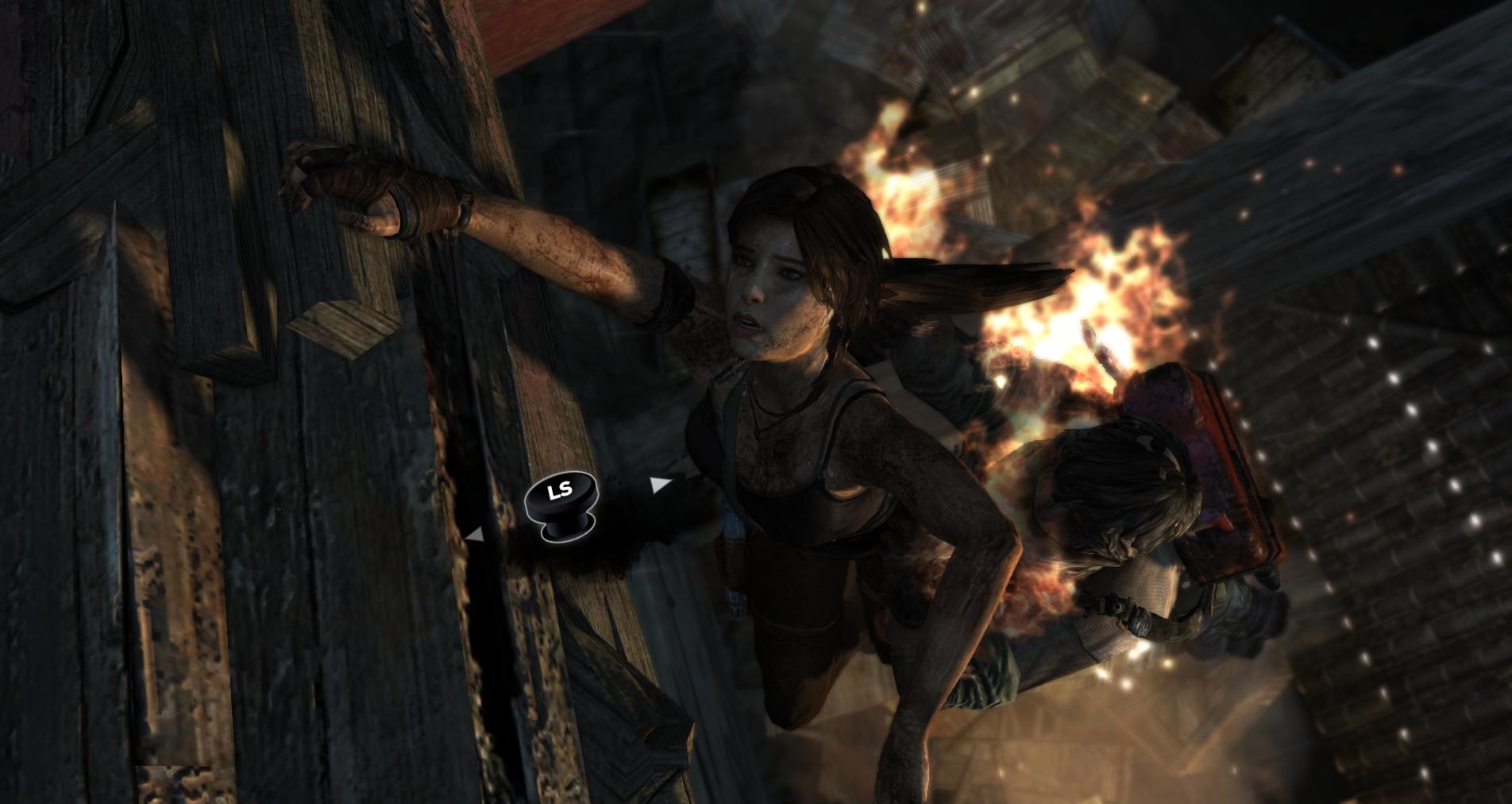
Failure scenes have become a separate art form. The new Tomb Raider sure has its share.

We've all had that one dream where something is attacking us and we can't do anything because it's a dream. In my case, I've dreamt that there's literally a snake in the grass in the front yard outside my house. I step into the grass, because it's a dream, the snake prowls around, lunges for me, end dream. I'm not particularly afraid of snakes, I guess I had recently watched or played something with snakes.

Then, one night, my dream changed. Same set-up, but this time when the snake lunged, time seemed to slow down and I saw a prompt for a dodge. The dream followed the prompt and allowed the snake to fall past me. The dream then prompted me to move in for a counter strike. I did, and, well, I can't really pull much more of the dream past that. Either way, waking up from that dream gave a very interesting feeling. My go-to dream for helplessness was completely turned around to be empowering. Because of video games? Because of quick time events?

Like I said before, quick time events are a reaction-based mechanic. They test your reflexes and hand-eye coordination by telling you a button to press and giving you little time to do so. Gamers typically have better association of buttons with functions than they do the labels of the buttons to their positions. I also mentioned how QTEs can be a gameplay translation of instinct. Instinct, which I define in simple terms as "being yourself quickly." That is, react as you would without taking time to revise in your head. It's empowering to know what to do and when. It helps you reaffirm your identity and proudly own it.

Heavy Rain, a PlayStation 3 title, was really ambitious with quick time events.

Video games always depict characters using instinct to save themselves or others from peril. In real life, ideally, peril is not ever-present. However, the opportunity to use our instincts is. For instance, I'm sure at some point in your life someone has approached you and said "hello." What did you do in return? Look at them and stare blankly while you decided between "hi," "hello," "good morning," or just a nod? Probably not. You picked a response and had a conversation. Your brain went through a little quick time event. Sure, nothing was at stake. Life would go on if you had said "apple," but all the same you were prompted and your instinct to greet the person back kicked in.

Saying "hello" isn't exactly the most intense example, but it is a relatable one. Real-life quick time events happen all the time. Some of them occurring in the form of decisions. Ever catch a ball that was flying straight toward you? Good job on that quick time event! Job seekers, have you ever seen a posting on craigslist that you qualify for but said "nah?" That was a quick time event that you willingly didn't respond to. The only difference is you won't come back to that moment to "get it right." This isn't guilt, just fact.

The fact that video game characters can respond to situations so quickly and expertly is why we see them as being strong. They don't second-guess what they're capable of, they just do what they can - or must. We too can be just like them. Sure, we won't be hitting any emergency brakes nor making jumps to safety, but we will be accomplishing commonplace feats that make us great people in our own home. Helping someone grab the milk on the high shelf, taking out the garbage, speaking up to volunteer, speaking up to not go through with something that you're being pressured into. All of these things which you may brush off or not feel "strong" enough to accomplish are more possible than you can imagine. It's not as simple as pushing a button, but it takes just as much effort when you set your mind to it.

Give it a try. See if, in your regular day, you can recognize a quick time event and do what you imagine it's prompting you to do. If you have any relatable experiences with real-life quick time events that you want to share, please post in any of the linked social media. I look forward to seeing responses. Until then, game out.

P.S.

I make quick time events out to be very promising, but in execution they actually have somewhat of a poor track record in gamer culture. See below for a humorous take.