Showing posts with label Video Games. Show all posts

Sunday, April 13, 2014

Kid Icarus: Uprising and Sportsmanship


When Kid Icarus: Uprising came out, I played the game's multiplayer religiously. I just loved the concept: Taking the weapons you built in single-player and pitting them against other gamers? Cool! And I'll stand by my opinion that Nintendo could take online multiplayer scene by storm if they expanded on Uprising's mechanics. But that's a discussion for another time.

For the uninitiated, Kid Icarus: Uprising is an action game for the Nintendo 3DS. You play as the angel Pit who battles the forces of evil in a mythology-inspired world. The controls involve moving Pit with the control stick while aiming and controlling the camera with the touch screen. There's a bit of a learning curve, but you'll unlock a very robust game on the other side. Pit's mobility and powers are influenced by the weapon he's using, and at 108 weapons in this game's armory, you will have your pick. Multiplayer is played the same way, but now you're competing with other players for glory.

I almost exclusively played the game's team-based mode, called Light vs. Dark. In Light vs. Dark, you battle in teams to defeat other players and decrease the opposing team's collective health bar. When the other team's bar is depleted, the last player defeated will turn into an angel. The angel is very powerful, but the other team wins if the angel is defeated. Thus it is a good idea to keep the angel protected.

The first few games of Light vs. Dark I played, my team won. When you win, you see your team's angel help the other team's angel up off the ground in a show of good faith, backed by an uplifting fanfare. When I first lost a game, I was a bit riled up and was not looking forward to what sort of humiliating results screen waited for me. Instead, I saw the exact same image of one angel helping another, smiling at each other, while the same music played. And I thought to myself, "What? No rubbing it in? No condescending musical stings? No huge 'YOU LOSE' covering the screen?"

A sample round of Light vs. Dark. Notice how even though the player loses, the results screen is still triumphant

Slowly, my confusion melted into elation. I no longer felt put on the spot. During the game, I felt frustrated because my weapon and skills were being outmatched. But hearing that music and seeing the two angels being friendly, I only felt the same sense of satisfaction that I would have if it were my team that had won. The game gives rewards to the teams based on who won, and of course my team's consolation prize was small compared to the winning team's purse. I suppose you can interpret that as the game focusing on who won and who lost, but it is only fair that the team which played the better game receives the significant reward.

Thus, we're back to the results screen, the one real opportunity that Uprising had to objectively make the teams feel one way or the other about the outcome of the match. To be honest, it's brilliant. Absolutely uplifting. The game could have really gorged the winning team's ego while stomping on the other teams', but it doesn't. I just couldn't bring myself to stay upset when I saw the angels smiling and that upbeat fanfare. I truly got a sense that the only thing the game wanted me to feel was that the match we just played was a good game. Nothing more, nothing less.

My friends, I want to see more of this: Games themselves promoting good sportsmanship through their presentation. That's not to say there are no examples of it out there, but the more the better.

I know promoting sportsmanship is a tricky business. How do we build a culture of mutual respect without going too far overboard and sheltering the participants? There's no one answer to this, but Kid Icarus: Uprising's approach is a pretty good take. And furthermore, it does this in a way that only a video game can. The bright and positive fanfare gives the losing team something encouraging to see and hear immediate after the game ends. This is the game immediately doing what it can to promote an optimistic outlook for that team. It's a counter-point to whatever frustration the losing players may be feeling following the match that just ended. However, the post-game rewards give a clear indication that not everyone is a winner. The winning team earns a free weapon in addition to a sizeable amount of ingame currency. This is done after the encouraging fanfare to frame the rewards as an incentive. It's as if to say, "Hey, you didn't win this time. But the next time you win, that's what you look forward to earning." There's a balance of themes there that may not be perfect all the time, but it's the best effort I have seen thus far.


When you lose in Team Fortress 2, you're forced to hobble around completely defenseless until you're killed or the next round starts

To contrast, let's bring up another multiplayer game that puts emphasis on the results of a match: Team Fortress 2. Team Fortress 2 is a first person shooter with a dark sense of humor that revels in shamelessness. This isn't necessarily a bad thing. In fact I have laughed with the game's dysfunctional and tongue-in cheek malice many times. And as such, the way this game ends its rounds is equally hilariously mean-spirited.

In Team Fortress 2, once a team wins, the other team can no longer fight back. An announcer shouts "You fail!" and a crowd boos while downtrodden music plays. The losers are stripped of their weapons and their running speed is decreased. In addition, the winning team's weapons are super-charged with critical hits. Essentially, the losing team is reduced to fodder for the winning team to hunt down until the next round starts. To top it off, this whole mechanic is called "Humiliation." And by all means, is there any better word to describe this situation?

So does that mean Team Fortress 2 is an awful game? Of course not. Anyone who plays the game will quickly be made to understand its hard-boiled nature and expect everything to feed into it. Humiliation is intended to be humorous to all parties involved. Objectively speaking, humiliation is a laugh riot. The team without weapons is bowled over by the team with the supercharged weapons? Who would have thought? This may be one of the only times when people are victimized and I'd say the only logical reaction is to laugh.

I'd also like to put in a good word for Uprising's single-player campaign. It is quite the adventure with some fun characters, snappy dialogue and no fourth wall.

If in the end neither game is seriously trying to personally make the loser feel bad, what is the difference that makes this article about Kid Icarus: Uprising and not Team Fortress 2? The keyword here is "authenticity." You can take Uprising at face value and trust it to be authentic with how it presents itself. There are no hidden or double meanings. There's something comforting about a game that works intuitively with how the human mind processes information and meaning. Team Fortress 2, on the other hand, requires a split-second of deciphering. Horrible things happen to your character not because the game is actually mean to you, but as a bid to be so over-the-top that you laugh alongside the game at the absurdity that it presents. So where Team Fortress 2 uses an overabundance of poor sportsmanship as a means of comedy, Kid Icarus: Uprising presents you with good sportsmanship and means it.

As things stand now, there is a lot more inauthentic humor than there is authentic empathy. That's because being inauthentic is easy, people like to laugh, and some cynicism can be healthy. What I want to see is more of the Uprising example. I want to see more authenticity not just in video games, but in the world as a whole. I want to see more people attempt authenticity. I want to see more people speak up for authenticity. I want to see more people react to and promote authenticity. We may believe that authentic culture "goes without saying" and that's why we see less outstanding examples of it in the media. As for me, the fact that I was so surprised to see it goes to show how much more I'd like to see out there.

And now I want to hear from you. What experiences have you had with games promoting good sportsmanship and authenticity? For all I know, there could be a game out there which depicts competition even better than Uprising does. Maybe you saw a movie or read a book where characters set a good example. Heck, maybe some of you have a story about a positive experience in Little League. If you do, I want to see it in the comments.

Wednesday, April 9, 2014

Borderlands and Media Intimacy

Game trailer for mature audiences

I have a friend who is an absolute Borderlands nut. He has internalized all of the lore, all of the characters and settings, and I'm pretty sure he knows every line of dialogue in the second installment. So naturally, during the run of the first Borderlands, he one day gifts me the game over Steam with demands that we play together. It's a big-name game and it has my good friend so riled up to play it, so I gave it a shot.

For the uninitiated, the Borderlands series is of the first-person shooter genre. You assume the role of an adventurer exploring the world of Pandora. The goal of the first game is to find a mythical stash simply called "The Vault," so adventurers of your kind are known as "vault hunters." You have four vault hunters to choose from, each with distinct weapon affinities and abilities that make their play styles very unique. It's a completely different game to start a new file as another vault hunter. As for the world of Pandora itself... well, the only way I can put it is "violently quirky." Imagine wild west with alien creatures, some future technology, and some of the most endearingly shameless dark humor I've seen in a game. Add in roleplaying elements and an impossible amount of weapon varieties, and you have a game formula that can last the avid gamer a very long time.

So I play Borderlands in a group of three. I had fun, but I really wasn't feeling the game. I was the only person playing for the first time, so the other two just tore through knowing exactly where to go and what to do. I meandered behind them by comparison and maybe got a few shots off. I was basically dragged through the game without any chance to catch my breath and try to get a feel for the game. I should have said something, but I was expecting to pick it up along the way. Coming off from these play sessions, I found Borderlands to be merely a solid shooter with a nice animated design and a sense of humor. For some reason, having this lukewarm response to the game didn't sit well with me, so I played some more. My friends were busy at the time, so I started a new character solo.

The original four vault hunters - Roland, Brick, Lilith, and my man Mordecai.

My friends, the difference was night and day. Playing the game at my own pace allowed for me to truly have a personal playing experience. I could slow down and take in the scenery without anybody having to wait on me. I could actually explore around the landscape and go off the beaten path to see what was over there away from the objective. Without my friends acting as a combined shield and battering ram, all the enemies shot at me and I had to fend for myself. I got to use different weapon types and see which ones suited my playing style and my skills. Heck, I even became aware of an entire aspect of the game.

You see, weapons in the original Borderlands came plain or in one of four "elements." Your weapons could simply cause damage, or also light an enemy on fire, destroy shields faster, destroy armored enemies quickly, or simply have their bullets explode. In a group, I was completely unaware of this because everything died so fast. But alone, I was forced to experiment with elemental weapons. Through my own trial and error, I saw which situations called for which types of weapons and I was able to build my own assembly of weapons that I switched through and used.

Furthermore, I got to learn about my character. I simply picked him because I liked his design, but I came to realize he was perfect for my play style. I tend to favor the handgun weapon types in shooters, and it turns out my character, Mordecai, had skills and abilities dedicated solely to this one weapon type. By building Mordecai into his "Gunslinger" abilities, I became my own wrecking ball of quick reflexes and precise shots. I was finally having the immense fun that was expected of me when playing this game. Nothing against my friends and their most well-meaning approach, but I only could have reached this level of intimate familiarity with the game playing it by myself.

A typical weapon in Borderlands. These things are as plentiful as rain and their attributes are almost always completely randomly generated. You will have lots and lots of guns pass through your hands.

And that brings me to the topic of this article, a concept that I have preliminarily dubbed "media intimacy." I would have called this "game intimacy," but I have realized over time that this concept applies to more than just games. In fact, oral tradition may have the honor of being the first media to engage people in media intimacy. The idiom "curling up with a good book" is a great example of media intimacy as well.

So, what is media intimacy exactly? As I define it, media intimacy is the connection between a person as an individual and any sort of media. If you've ever "gotten into" a movie, TV show, book, or even a live performance, you've experienced media intimacy. You're more than just a consumer. You feel like you're part of whatever it is that you're watching, listening to, or playing. A "fan" of something is a person who is intimate with the media that they are a fan of. Even if all of someone's experiences with the media have only been as with a group, it takes just one individual thought or interpretation to spark an interest. And when this person engages in just thinking about the media on their own terms with nobody else to influence it, media intimacy begins.

Thus, when I played Borderlands by myself and engaged with it on my own terms, I became intimate with the game. The gameplay was more significant to me. The characters were more significant to me. The story, the setting, the individual events and lines of dialogue, all significant. I could more appreciate the game as a sum of its parts and not just as another example of its genre.

The most recent game that showed me a good time via media intimacy is Bravely Default. Such a deceptively complex game, but the most rewarding when you put in what little effort is needed to learn its ropes.

When I came back to playing Borderlands in multiplayer with my friends as my custom-built Mordecai, I was far more proactive. I got right into the fray and knew what weapon to use against which targets. I knew what events were happening, so it didn't bother me when we glazed over the cinematic sequences. I knew what went into a good weapon, so I didn't just pick up and drop anything just because it had an impressive design. We finally were all playing the same game. I was truly a vault hunter and I couldn't be happier.

And by all means, if we can be intimate with our media, why can't we be intimate in other areas of our life? How about business intimacy, or professional intimacy? Art intimacy or, hear me out, social intimacy? The common thread here is you engaging with your chosen topic on your own terms. You need to want it for reasons all your own. That's not to say you can't be influenced by the ideas of others, but the way you process those ideas need to be yours and yours alone. Thinking or acting some way just because someone else said so isn't intimacy. Or at least that's how I see it. After all, if you're taking any of my words to heart, you're engaging in media intimacy right now by taking in my words and processing that information.

Case in point, I am currently taking classes to learn programming. And as it stands, I'm hard-pressed to really get into programming when I just think about it in terms of assignments, grades, and lectures. But when I'm by myself and think of programming languages as fun tools with which to build fun programs, I find it much easier to learn and love programming.

Now I'd like to hear from you. Now that you have some idea of what I'm talking about, what are your experiences with media intimacy? What are you a fan of? Has a game, book, movie, TV show, etc. really made an impact on you? I want to hear about it.

Monday, March 31, 2014

Elite Beat Agents and the Meaning of Passion


Video game concept: A group of snappily-dressed gentlemen travel the globe and inspire regular people by dancing to popular music. Hope and motivation would be in short supply if not for these suit-wearing male cheerleaders.

If you're wondering what such a game would be like, look no further than Elite Beat Agents for the Nintendo DS. This game absolutely took the handheld scene by storm during its release and people I know are still making references to this game. Just like in the paragraph above, the game is about the titular agents as they travel the world and spread passion to the people. How do they do it? By acting as cheerleaders singing and dancing to popular music.

As you can tell by now, Elite Beat Agents is set in a modern world of cartoon fantasy. And even though the game revolves around the agents, the stars really are the people that the agents inspire. These aren't your typical video game problem-solvers. Instead of saving the world, our protagonists have more relatable goals and issues such as babysitting, creating art, proving their worth or just trying to survive in a rough-and-tumble culture.

Some typical gameplay. The player is following the beach ball left to right and afterward going to tap the 2 and 3 buttons

Instead of saving the day behind the scenes, the Elite Beat Agents are all about filling their targets with the courage and passion they need to do it themselves. This being a game, simple problems quickly turn into wild adventures. But the themes of overcoming doubt in one's abilities are still there. Let's quickly go over how this game is played.

For the uninitiated, Elite Beat Agents is a rhythm game that tasks the player to tap buttons on the DS touch screen following the melodies of well-known songs. These buttons fade into the screen and have circles closing in on them, indicating the right time to tap. In some cases, the button then prompts the player to follow a path on the screen, or some other follow-up motion. The result is a whole routine of button-pressing that compliments the song perfectly. As the song goes on, there is a status bar on the top of the screen that goes down. Should it empty entirely, the stage is lost and the player has to try again. This bar is bumped back up by the player performing the song well. This gameplay does very well to excite and push the player to do well and earn a good ending.

On the note of endings and stories, Elite Beat Agents has some of the most energetic presentation I have ever seen in a game. It's rife with passion, over-exaggeration, endearing charm, great characters, excellent themes, and is just a pleasure to experience the whole way through. Let's take a look at one of the game's stages.


The "Makes No Difference" stage - Interesting because the outcomes rely on the lead actor, which relies on Chris's directing

Stage 2 of the game introduces us to director Chris Silverscreen as he works hard to produce the next great blockbuster hit. Morale drops when one of Chris's bosses comes onsite to tell him that his job is strictly on the line. Chris carries on, but the extra weight is dragging him down. Chris's self-doubt and stress pile up, culminating in the desperate cry of "HEEEAAALP!" Thus, the Elite Beat Agents embark to motivate Silverscreen and make "Romancing Meowzilla" a huge hit!

I really must stress the significance of the "HEEEAAALP!" screams in Elite Beat Agents. It's the call that summons the agents to the target's aide, but it means so much more. The emotion that drives every character to yell this call is a very relatable one. Even though the situations are different, the emotions are the same: Self-doubt, anxiety, stress, maybe even helplessness. In short, the nagging voice that says "I can't do this. This is way bigger than I am." I am absolutely sure every person has felt this at some point. Perhaps some among us are feeling it right now. And I can assure you many of us will feel it more times in the future. Thus, I am certain we can all relate to feeling this emotion, especially to the point where we would shout "HEEEAAALP!" if it meant receiving any degree of help.

You can see the magic of the agents right away when they lift Chris straight out of his funk and get him waving with the music. After all, the best start to a daunting task is to loosen up. A little bit of waving with the music to take his mind off of the stress of the task will only help. You may also interpret this as him "riding the wave" of positive thinking and progress. This will be more significant in a few paragraphs.

Here you can finally see the game in action. All gameplay is reserved for the bottom screen while the top screen shows Chris as he works toward producing his movie. On the bottom screen, the  buttons appear to the beat of the music and you will gain points for tapping and dragging, depending on your reflexes and timing. Your performance not only affects the meter that you keep above failing levels, but it also affects how the events on the top screen play out. Performing the gameplay well will depict Chris as making progress. Performing poorly will depict Chris as struggling or failing to reach his goal. Performing perfectly will depict Chris succeeding greatly and with infectious gusto.

I find this very well represents what it's like to progress through a daunting task. You'll have your highs and your lows, and moments when you're just coasting through with moderate progress. In fact, depending on your task, you may coasting much of the time.

More sample gameplay. The circles around the buttons close in and when they overlap with the border of the button, that is when the player must tap.

The music you're hearing is a cover of Sum 41's "It Makes No Difference." And I must say, Elite Beat Agents has one of the most memorable soundtracks not necessarily because the songs on it are all original and of great quality - in fact, the entire core soundtrack are all covers of popular music. What makes the songs stand out is the context that they are used. In this game, music and gameplay are intertwined. The routine of button-pressing is set to the music, so you become intimately familiar with the music out of necessity for playing the game well. I find that this set-up has given me a fondness for all of the songs in the game's soundtrack. It helps that when you perform well, these songs are the background themes for your awesomeness. You can see comments all over the Internet from people who have a problem with popular music saying that this game makes it enjoyable.

You'll notice that in this game, stages take place in typically four sets. At the end of each set, depending on if your meter is above or below 50%, an event occurs that shows if your protagonist succeeds at the immediate task. In the case of this stage, we see if Chris's directing pays off and his lead actor pulls off the performance of a lifetime. In this stage and any other, seeing these little victories along the way to completing the stage is very rewarding. Remember that quivering ball of doubt that your character was at the beginning of the stage? Well look at what they're doing now!

Between sets, we return to seeing our character doing the wave, but as the stage progresses we see more characters joining in. I love this aspect of the game, since in my eyes it signifies the point when those characters are "on the same wavelength" as our protagonist, so to speak. It's one thing for Chris's lead actor to do his job, but it's another for him to really understand Chris's passion and motivation. With the lead actor joining Chris in the wave, I feel like he's really on board and sharing in that passion to make a great movie. Later on, even the antagonistic executive joins the wave, which goes to show even the bad guys in these stories see things more the protagonists' ways. To be fair, the executive does soften up when he sees the progress made in the movie.

The ending you get for a stage is based on how many sets you passed. The best ending is if you pass every set, there's  a neutral ending if you miss any sets, a bad-ish ending if you miss all the sets but still pass the song, and running out meter entirely will "reward" you with a soul-crushing failure scene. Trust me, these are hard to watch. In Silverscreen's case, all of his efforts and directing prowess pay off. "Romancing Meowzilla" is a huge hit, he makes his bosses happy, he keeps his job and can keep doing what he loves.

For me, what's more rewarding than winning in this game is seeing the evolution of its characters as the stages progress. They go from self-doubt to unflinching confidence - which you may notice is signified with a very distinguishable face bearing sharp half-circle eyes like masked superheroes - something that I refer to as the "fervor face." It's the face of a person who is well past the point of "Can I do it?" and only focused on where and how to make it happen. I love it.


The "Sk8er Boi" stage - A prime example of the protagonist using the fervor face

The next stage places us in the backseat of Jack, an ace taxi driver. He's good at his job, but he has a problem driving too fast. After being let off with a "friendly" warning from a police officer, a woman in labor barges into his car and tells him to step on it for the hospital. Jack can't risk being caught speeding again, but time is of the essence. With nothing else to do, Jack starts his engine and makes for the hospital with a shout of "HEEEAAALP!"

As we can gather, most - if not all - of the cries for help are not so much "This is out of my league, please help me out of this responsibility" but more "I'm going in to make this happen! Back me up!" For characters like directors and taxi drivers that are normally mundane in video games, this is a great attitude. The music for Jack's stage is Avril Lavigne's Sk8er Boi. The fun part about this song is how it tells a story, thus the lyrics are prevalent and clear. Even though the lyrics don't have much to do directly with the events of the stage, I still feel there is some connection. Perhaps because the pace of the song's story arc matches the stage's pace and there's some synergy when both stories are at their climax.


The "YMCA" stage - Look at this man tear through his plight

Another of the game's stages which makes great use of lyrics is the game's seventh stage, in which we join the quest of a sailor out to find treasure. The song for this endeavor is the time-tested and iconic YMCA, credited as being covered by TC Moses. And I must give props to TC Moses because regardless of if this song sounds like the original or not, the version we have in Elite Beat Agents is every bit as fun and energetic. I know I would be down to explore the depths of the ocean to such a tune. I can't tell you how pumped I was just hearing the initial horns and drum beat.

The "Anthem" stage - The story of a wash-up who hasn't given up on himself

The last stage I want to mention is the game's fourteenth stage, featuring an allegedly washed-up baseball player, Hulk. He had his run in the big leagues and struck out in more ways than one. He lives a life downtrodden melancholy until one day when the amusement park he works at is under attack from a volcano monster. It's up to Hulk to save the park from destruction using weaponized baseball skills! Of course, this story isn't as down-to-earth as the rest, but the themes are possibly deeper. Hulk has already seen the worst brunt of failure and yet puts in the effort to save the park and his biggest fan who is caught in the action. To me, that makes Hulk's story powerful in its own right. Rather than avoiding failure at all costs, he is overcoming the current paralyzing effects that a past failure can have on a person.

In the end, the power of music may get our protagonists up and doing, but it is the power of passion that makes everything possible. Behind every character and story is some sort of passion or drive. The same can be said of anyone. Every person has something they're interested in, and if we could we would pursue those interests with our hearts and souls fully invested. However, many of us don't pursue these interests for a variety of reasons. Either we don't find them practical as a living, we believe we don't have what it takes to make a living of it, or we just turned to the more practical occupations to place all our effort. And in some cases, the more practical occupations are our passions and we're as happy as can be. In any case, we all have something we want to do and do it well, and in a perfect world, we would all be masters of our trade. And to all of the masters of their trade currently reading this article, I commend you.

In Elite Beat Agents, antagonists take the forms of executives, traffic cops, aliens, unruly children, and the weather itself. But the real conflict throughout the entire game is people versus themselves. Every character is perfectly capable, but the only thing stopping them is their own self-doubt. Once they get that confidence, the problem doesn't stand a chance. It's in this way that we might even think of the agents themselves as purely symbolic. It's incredible to think all these people can gather the courage by themselves, but more comforting and empowering to think that we all have this group of agents somewhere in the distance confident enough in our ability to cheer us on by dancing to popular music.


The first stage of "Osu! Tatake! Ouendan" - The simple story of a student needing to study for exams

And I can't end this article without talking about Ouendan. Many people in the gaming community already know about Ouendan, so they can skip to the next paragraph while I clue the rest of us in. "Ouendan" is the colloquial name for "Osu! Tatakae! Ouendan" the Japan-only game to which Elite Beat Agents is an international "sequel" of sorts. I'm no expert, but I'll explain this as best I can with my limited knowledge and research: An Ouendan (spelling may vary) is a Japanese cheer squad not unlike cheerleaders in function. Though whereas cheerleaders rally up support by having a good time, the typical Ouendan will instead deliver an intense, stoic performance. I imagine it's because they take belief and inner strength very seriously. Thus they project such a professional tone to help their team's resolve sturdy up as well.

The Ouendan game very much takes a stoic approach to passion and motivation. Compared to the Elite Beat Agents, the Ouendan members are serious. Not mean or disagreeable, just very intense and focused on their task of bringing drive to the people. Instead of doing the wave, character in Ouendan put on their fervor faces back with the flames of passion. I guess you can say the attitude in Elite Beat Agents is "Take it easy, you've got this" and the attitude in Ouendan is "You are so capable of overcoming this challenge that it is your solemn duty to do so!" Personally, I can see how the stoic approach well represents Japan while the laid back approach powered by popular music appeals much more to the general international audience.

Different though their methods may be, Elite Beat Agents and Ouendan both set out to celebrate the common person and to me they succeed. Every profession, hobby, and undertaking in these games are shown in an impressive light. And you know what, in the right light, that applies to us in real life as well. Anyone can truly seize life if they keep their passions front and center in their minds and in their hearts.

We can't discount the power of music, either. With my playlist open as I type, I can vouch it helps. How about you? What music do you listen to that gets you in the mood for what you love? Perhaps the next time you listen to it, you can imagine a squad of agents dancing to it in the distance.

But before we sign off entirely, let's cut some onions

Wednesday, November 13, 2013

Wii Fit and a Spoonful of Sugar


It is the middle of November and by now people all over the world are exercising to their trial versions of Wii Fit U. I am one of them, which is good since I fell out from being consistent with the first Wii Fit. But I'm back on the Balance Board and things are looking up! I have already partaken in many of Wii Fit U's games and I am having actual real fun! And that fun is pivotal to today's topic.

"Wii Fit" is a household name to many, but for the uninitiated, Wii Fit is a game that gets the player to exercise. Since the game cannot provide physical feedback like standard exercise machines, it instead provides instructions and challenges that require the player to pose and move around in certain ways. For instance, Yoga exercises in a Wii Fit game show the player how to adopt a given Yoga position, then assess the player's ability based solely on how able he or she is able to maintain their balance on the Wii Balance Board. I could choose not to do the pose and stand comfortably so that the game would give me a favorable rating, but beating a video game wasn't exactly on my mind when I chose to buy Wii Fit.

Wii Fit U offers many yoga exercises, strength exercises, dance steps, balance games, and more, but what really got me inspired writing was my first experience with Wii Fit U's "Free Step" exercise. The activity is a simple one 1) Step on to the Wii Balance Board with one foot while raising the opposite arm and moving the other arm back. 2) Step on to the Wii Balance Board with the other foot while returning your arms to a neutral position. 3) Step off the Wii Balance Board with the first foot, this time raising the same-side arm and moving the opposite arm back. 4) Step off the Wii Balance Board with the second foot, returning your arms to a neutral position. It takes some getting used to, but Free Step gives you plenty of time to adjust. How much? Oh, in the area of a half-hour.

This deceptively simple screen has everything you need to step like a pro

If that last bit made you say "What!?" let me tell you my reaction was very much the same. When you start Free Step, you are given the option to quit at any time. You are also given the goal of completing over 2000 steps within that time. The game can work off of the Wii U's Gamepad so that your TV can be freed up for other things while you step through your half hour. Since my first playthrough of Wii Fit U was intended to just be a trial run to see what the game had to offer, I figured I'd do a good 100 steps and call it to see what else I could do.

So, I was off. The screen displayed a stage where my character and a bunch of my handmade Mii characters had their own Balance Boards. The onscreen character automatically did his steps, which was my prompt to imitate him to make sure I'm doing it correctly. The game even provides a helpful stepping sound effect to signal the moment when your moving foot should touch down each time. I took all of these into account and began my steps. The game only counts steps you actually do, and uses pressure on the Balance Board to verify those steps.

As I worked to imitate my character as close as possible, stay in step, and switch feet as smoothly as he did, 100 steps came and went. I don't know what it was, the step counter, the little Miis standing around supportive, the trainer's voice informing me of my progress, or just how little I looked at the ingame timer counting down from thirty minutes, but I was feeling pretty good. The steps weren't physically demanding at all, but I was still working up a good amount of effort. I was also getting bored, but in the best way. I got the idea of what to do and the steps were too slow. I then noticed that Free Step has three tempo settings and I had been stepping to the lowest one. It was time to get Wii Fit! I clicked onto the second setting, found it alright, then clicked onto the third setting. And then I was off for real.

As the minutes ticked down, the steps ticked up. With four steps in a cycle, it was 25 cycles for every 100 steps. At some point, the trainer even stops using specific numbers when telling you how many steps you've done. That's a good indication of when you're high up there! Over the half hour, I could move in tandem with my Mii on the screen and switch feet on the fly seamlessly. Pretty soon I was looking at the clock, but only to get an impression of how many more steps I could get out before the half hour was up. I was in a state of Zen that I was in no rush to leave. And yet, all good things come to an end. When the half hour was up, I had done well over 2600 steps and could feel them all in my thighs. And I still went for another 15 minutes on other games to round out the full hour of exercise.


Some of these games take crazy coordination. I love his enthusiasm!

Now, I consider myself middling at best when it comes to work ethic for exercise. Yet here I was putting in half an hour straight of steps. What happened? My friends, gaming happened. It's easy to feel negative about exercise if you haven't done it in a while, but it's even easier to feel positive about games, especially if you haven't played any in a while. Wii Fit U managed to take the eagerness I normally reserve for games and redirect it towards exercise. Whatever associations may be keeping me from exercising were rendered null in the face of my overwhelming love for games. You might say that the game "tricked" me into exercising, but I certainly don't feel tricked. And if it is fact that I was tricked, that's my kind of trick!

This experience taught me the importance of associations in human psychology. We as people can have very warped senses of priority based on previous experiences. This is where procrastination comes from, after all. I hear all the time about workers who have a report due the next day and they'll play five lives in Candy Crush before even looking at said report. It's not even a contest. It's also easy to understand how that happens. Candy Crush is fun, colorful, and gratifying. Comparatively, the report is arduous. Imagine if the worker could channel that eagerness from Candy Crush to that report. After all, that individual report needs to only be written once while Candy Crush will always be there.

And that's basically what happened with me on the Wii Fit U. I can't speak for everyone using the software, but I have gone on to incorporate more activities in my usual exercise routine and be more consistent with it. I may not have the benefit of a game tracking my progress, but the positive experiences I had with exercising filled in those gaps. I less thought about exercise as something strenuous and more like a cumulative activity that I am meant to improve and build on. Even if it were scientifically proven that exercise shouldn't be possible and fun, I am able to keep doing it as if it were. Thus, I was "tricked" not only into doing exercise, but enjoying it as well.

Two saying passes through my mind in response to this. One was "Give a man a fish and you feed him for a day. Teach a man to fish and you feed him for a lifetime." The other one was "A Spoonful of sugar helps the medicine go down." Though the first one is relevant, I believe my case with Wii Fit is more accurately described by the other. Many will recognize this quote as sung by Mary Poppins to motivate the Banks kids into cleaning up. Literally, the quote refers to the general bitterness of medicine and a child's unwillingness to take it, even if sick. But adding a spoonful of sugar will make the medicine taste appealing enough for the child to take. In context, Poppins is saying that menial tasks can be completed quickly and made fun if you don't think of them as menial and more gamelike. Sure, the film depicts "fun chores" as simply snapping one's fingers and watching the room clean itself, but clearly that is symbolic for how easy it is to clean one's room when you're having fun while doing it. At least that's how I choose to see it. And I digress.

Ms. Poppins explains it best herself

I would encourage official study into this topic of enriching non-game work ethic with game-like incentives, but that actually has been well underway for years. Many of you probably have been thinking the term "gamification" throughout this whole article, and you'll all be right. For a quick reference to what gamification is, I point you towards this early Extra Credits episode on the topic. Very good viewing. And as you can see from the video, gamification is still very early in its development and has incredible potential for growth, but it still represents everything I've been talking about throughout this article. In fact, you could say everything I've been writing about since March is a case-by-case argument for gamification's potential.

How about you? What experiences have you had with motivation in video games? What are some times where game-like thinking have helped push you along, or even been key to solving a problem? I have found that when I go into a game, I come into it with a sort of neutral optimism because I know the game was designed with my success in mind. This is an attitude that video games do in a way all to their own. I'm not even aware of this positive attitude, but I have brought it with me to non-game situations and been all the better for it. I'll bet every gamer also does this and has a great story from it.

Thank you for reading, and I'll see you in the Wii Fit U Gym Communities!

-

Email: RBAshkenazi@gmail.com
deviantART: http://captain-gamer.deviantart.com/
ScrewAttack: http://www.screwattack.com/user/captain-gamer
Tumblr: http://captaingamer.tumblr.com/
Twitter: https://twitter.com/Captain_Gamer
YouTube: http://www.youtube.com/user/GamerHangVideos

Thursday, August 1, 2013

Phoenix Wright and Focus


By now, my Nintendo 3DS is my preferred exercise companion on the treadmill. Sure, other devices offer similar services, but nothing captures my attention like a good Pokemon battle, RPG cutscene, flight around Wuhu Island, or courtroom drama. For today's topic, we will discuss why that last example is so effective.

We all can agree that the Phoenix Wright games really make us think. Capcom's law games create these little worlds of scenarios, character, evidence, and motivations. At its most intense, I have found myself so immersed in a Phoenix Wright storyline that I began seeing the real world in terms of alibis and some way in which a murder could have been hidden.

Officially known as the "Ace Attorney" series, some games in the franchise even star other characters and take place at various times in the world's history. Phoenix Wright just happens to be the most recognizable aspect of the series .

For the uninitiated, Ace Attorney games work your problem-solving skills more than they do your reflexes. You won't be defeating enemies one after the other, nor won't you be grinding up stats, picking up loot, earning weapons, or even much of controlling your characters. The bulk of Ace Attorney gameplay is in its dialogue. You will spend more time hearing characters talk and explain things than you will taking any sort of action.

Everything happens in menus, and every option opens up a colorful and endearing new event

On paper, this sounds dreadfully boring. But in execution, this is perhaps the most enthralling way to play a video game that I have yet experienced. Like I said above, an Ace Attorney game is more than interactive media. It is a window into a world of intrigue and murder mystery. And yes, every court case boils down to murder at some point.

Every chapter follows the same formula: Your main character meets a person who is charged with murder and takes the case to defend this person. From there, you hit the streets to scour the crime scene, find evidence, and talk to people related to the incident. The games are all very linear, so you'll be following a carefully crafted storyline the whole way through. When your investigation is over, it's time to head to court where you will engage in debate with the prosecutor, whose job it is to see your defendant found guilty.

Already you can see how Ace Attorney can keep a person hooked. The gameplay and the storyline are chained at the hip. Whereas most of what happens in a video game is part of the "experience" and you can go for long stretches without continuing the story, Ace Attorney is in storyline mode full-tilt. If the game ever stops, it's because it needs you to nudge it in the right direction. You are never not ingrained in an Ace Attorney storyline for as long as you are playing it.

By now you're probably wondering what it is the player actually does which presents any challenge. Well, there come times in the story where your protagonist will have to put money to mouth and prove their point with some evidence. But they won't do it by themselves. When you hit that impasse, it's up to you, the player, to sift through the evidence and find that piece that will throw doubt on the other person's claims, forcing them to elaborate or admit to lying. So, if your witness claims to have never been at the crime scene and yet you found their phone right next to the body, time to raise an OBJECTION!! Digging up the truth is very rewarding, and watching your character pursue that line of logic further just makes it all the better.

 But allegedly, the victim wrote the defendant's name with his right hand. Curious...

Bringing it all together, what does this game being good have to do with me being on the treadmill? Nothing, directly. But it does help me focus on the exercise. And funny enough, it helps me focus by taking my mind all the exercise almost entirely. And let me say ahead of time that this is a particular sort of multitasking that not everybody can do, so be careful if you try it out.

First, by concentrating on the game I am less aware of my surroundings. Not by a whole lot, just enough to where I am not constantly checking the clock, calories, or distance. This way, I won't be thinking about how much further I need to go. Likewise, since I'm not focused on the strain of the exercise, I won't have any reason to exaggerate how tired I feel just to give myself a reason to cut it short.

Second, the attention that I am not giving to the exercise pours straight into the game. With the amount of attention that game commands, it's not likely to let go of that focus any time soon. The storyline is constantly in motion, so at any time you can just click on it to see more. Further, the conversations and characters are entertaining enough where pretty much any exchange contains at least one smirk or laugh out of the player. There is a lot going on at any time in the game, so you'll be thinking about the storyline and what the newest developments mean for the larger mystery afoot. Even putting the game down to think about something will keep you invested enough to where you won't get bored while exercising.


The game's music is also exceptional and has everything to do with the Ace Attorney experience. The iconic "Cornered" theme is catchy, especially in a capella.

There are two caveats for this method. First, playing a game while exercising requires being able to multitask in a very particular way. While I can stay enthralled in my game, I still need to keep up with the treadmill, maintain balance on the belt, and keep an eye on the timer so I can scale up the speed according to my routine. If you cannot multitask like this, then this whole method could prove dangerous. Practice first on low speeds, even if you already multitask well.

Second, there do come those times in an Ace Attorney game where you will get utterly stumped. The solution is out there, but your thought process won't find it. In those cases, the game's hold can wane. In that case, you may want to switch up for a game that doesn't require problem-solving to continue, like Animal Crossing.

These things aside, I have a great time on the treadmill with 3DS games, Ace Attorney in particular. If the story really picks up, I might even pull some overtime just to keep in the zone.

All of that said, I'd like to hear from you. What activities keep you in "the zone" like a good game does? Which activity would you like to have a zone for? A game-like perspective on that activity may help in accomplishing this. On the other side, what are good games you like to play while doing something else? And on the other side of the other side, what are some things you like to do while playing games? I know I like to wind down at the end of the day by catching up on my videos while playing some Borderlands 2 or Cube World. I look forward to seeing what you all have to say! Until then, game out.

Tuesday, April 23, 2013

Dead Space and Being the Silent Protagonist


I love the first Dead Space. By now, the Dead Space series has made a big name for itself and spanned three installments with some games and literature on the side. But before the brand took off, there was just the one really ambitious title. Dead Space has great atmosphere, looks incredible, employs creative enemy designs, and gives players a satisfying variety of weapons. It's also one of the definitive games that emerged from the boom of American-made horror titles in the late 2000s. Don't quote me on this, but I imagine the immense success of Capcom's Resident Evil 4 got that ball rolling.

There is one aspect of Dead Space that I think is vastly understated even today. Later installments even did away with this precedent that I thought was pretty important. I am of course talking about the fact that protagonist Isaac Clarke never spoke. Everyone else carried conversations naturally, but Isaac himself never got a spoken word in edgewise. The game covers for this by having all the conversations scripted in ways that don't require Isaac's input.

The silent protagonist in video games has been around since video games themselves. When the main character of a game lacks a voice, it becomes easier for the player to project themselves in the character's place to be more engaged in the game's settings and situations. Gamers most often think of iconic silent characters such as Crono, Gordon Freeman, Link, and other characters who never actually speak in written dialogue.


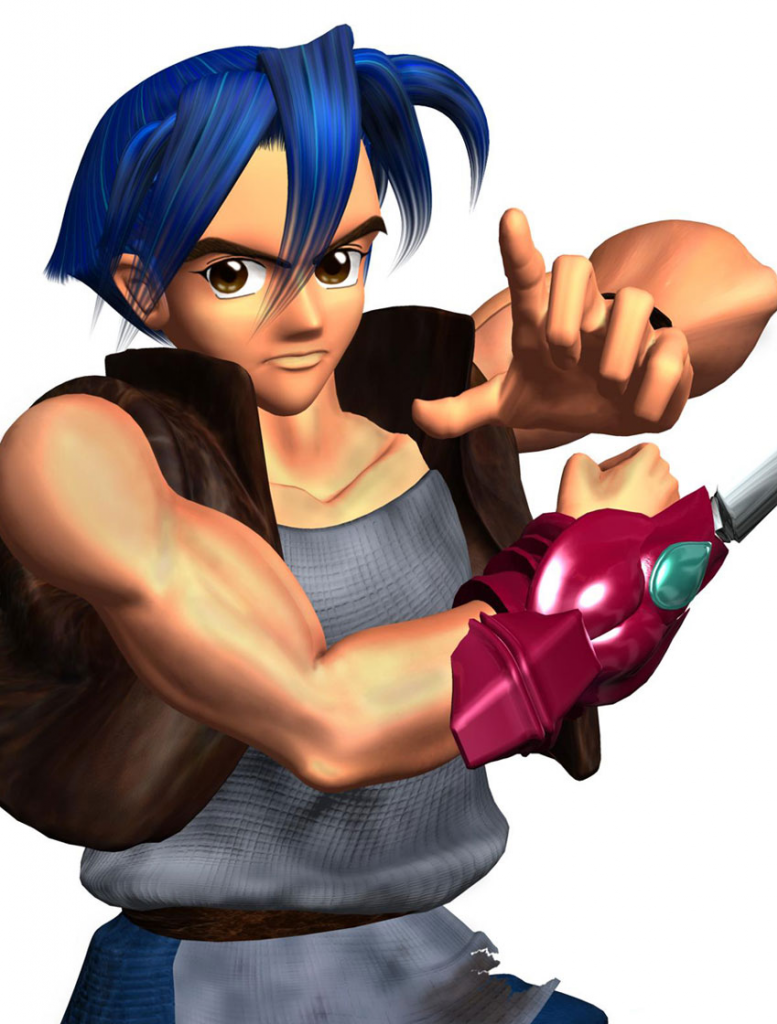
Vahn from Legend of Legaia is my obscure silent protagonist of choice

However, are these characters really silent? These silent characters clearly communicate through the course of their games. For instance, a character's dialogue with the main character will come off as a conversation with him or herself. "May I help you? Oh, you want the water gem? I can't give it to you unless you slay the dragon. You'll do it?" In Mario and Luigi: Superstar Saga, the plumbers have dedicated animations for when they speak. Even though their words come out as a string of comical gibberish, they clearly hold functional conversations with the other characters of the game world. There are games out there where the main characters don't communicate, but I feel this has the most impact in Dead Space.

Let's examine the situation: In Dead Space, Isaac is stranded in a derelict space vessel that is infested with horrifying monsters. He is not entirely alone since he maintains contact with two colleagues, Kendra and Hammond. While Isaac braves the depths of the USG Ishimura, Kendra and Hammond remain in relative safety while they figure out what's wrong with the ship and how to escape their predicament. For most of the game, everything Isaac does is not his idea. He simply moves from order to order issued to him by other people.

Further, the game is scripted and acted in a way that Isaac's silence just feels natural. The way the characters interact with him, you get the impression that they are used to carrying a conversation with Isaac. Instead of Isaac simply being slapped with the stigma of silence for effect, that may just be part of his character to be soft-spoken, if spoken at all. All of this, combined with the way he moves like a civilian, has Isaac strike me as an introvert. Quiet, maybe a little awkward, evasive but not reclusive, and generally a softer personality type than what Western media typically offers.


A great documentary going into the thought process of using a nonstandard hero.

Given this, your first impression of Isaac may be that he is a weak character. In fact, his situation could be downright insulting. One of the first things that happens in the game is Hammond ordering you to hack open a door with about as much enthusiasm as turning a doorknob. If you were in a bad mood, you might have felt that your character's life skills and expertise were being marginalized by his role.

You know what, you'd be right. Despite the fierce appearance of Isaac's protective suit, he never struck me as a person of action in the initial minutes of the game. It served as a great contrast for when as the game escalated, we'd see this character forced to rise to the situation.

And even though Isaac doesn't talk, that doesn't mean he can't think or feel. He feels terror plenty. Any time he takes damage or worse, you can hear his muffled cries of pain and fright through his helmet. Should you fall prey to one of the game's gruesome death scenes, you'll hear just what Isaac feels about the situation. I absolutely loved this aspect of the game since the muffled cries invoked a claustrophobic feeling because the character couldn't be heard properly. It goes to show that Isaac's silence becomes a source of strength since he maintains it in a hostile environment. Silence both of word and emotions. He is plenty scared, but isn't letting it affect his ability to do something about it.

The second way Isaac expresses himself is through his personal log. Though it's mostly a game mechanic to remind the player of what they're supposed to be doing next, it's still written in Isaac's "voice." The logs depict Isaac as rational, focused, nonjudgmental, and given the situation, scared. He rarely writes anything personal about others, unless it's a response to storyline developments. This limited exposure allows us to see Isaac as the most level-headed person on the ship. He clearly feels more confident in expressing himself with the written word above the spoken word.

Watch the first minute. Seeing Isaac straighten his posture to fight this monster is my favorite moment.

The big payoff in all of this character analysis is seeing Isaac get work done. Here we have this wallflower of a character and he's the one destroying monsters, making repairs to the ship, and saving the day. It's hard to appreciate this character development when it's actually us, the players, doing the real work. We're more inclined to celebrate our own victories rather than keep our perspectives all within the game world. Objectively speaking, Isaac can deliver. Though not very impressive as a communicator, Isaac shows his strength of character through his actions. We could have had a main character with all the vocalized confidence in the world who could have done the same thing, but because our first impression of Isaac was not as strong, that made his actions all the more meaningful.

The more I think about this and how organic of a character Isaac Clarke is, the more I thought about how this translates to the way we act and see others in the real world. I'll admit right here that I based my vision of Isaac Clarke largely on my own introverted self. As I analyzed Isaac and how his actions have meaning, I came to realize that I too benefit from my actions. Whenever I come out of my shell to do something, it always seems to grab attention. Conversations start, we keep in touch, and before I know it I have new friends and acquaintances that I am comfortable enough around to cut loose a bit more and approach.

Just like Isaac, we all have some area that we have our strengths in, our proverbial "good sides," if you will. We just have to figure out how to display this good side to others and use it as a gateway to introduce those others to our beautiful personalities. This is why self-help gurus often recommend volunteer work to help people find friends. The fact that you are doing volunteer work shows your fellow volunteers and others that you are the sort of person who does volunteer work. If you are artistic, find a venue in which your work can be displayed for others to see. I'm doing that right now by sharing this blog with all of you! And it has worked. I've met some new people and hope to meet many more as I continue to write these posts.

Now, how about you? What is your "good side" that you would love sharing with others as a way for them to get to know you? Can you play sports well? Do you like movies? On the other side of this post, which video game characters do you consider strong and well though-out? Maybe you see a character different than most people do. Maybe your reasons for liking a character are personal. I would love to hear all the varying responses and reasons. Until then, game out.

Thursday, March 21, 2013

Quick Time Events and the Subconscious


The laugh track. The sound board. The wide-angle lens. As media evolves, it develops new techniques. Either because of advances in technology, or simply because an idea sees great success and becomes a trend. Video games have seen plenty of its own techniques as the time has passed. One of the more divisive techniques of the modern school of gaming is the quick time event.

For the uninitiated, a quick time event (QTE) is a gameplay mechanic in which the game prompts the player to press a specific button to achieve a certain goal. This is different from regular gameplay in that these button-presses are context sensitive. Where the A button normally makes you jump, in a QTE you'll be prompted to press the A button to have your character jump out of the way of a falling rock. QTEs are characterized by being reaction-based and generally trying to give a gameplay translation for a character's instincts.

I can trace the evolution of the quick time event in three landmark games. The first game is Shenmue, released for the Dreamcast in 1999. During the course of the game, main character Ryo Hazuki is put in several situations where he must avoid something, catch something, or give chase to someone. In particular, the chase scenes involved Ryo dodging obstacles and choosing paths. For the cinematic effect, regular gameplay was probably not intricate enough or too awkward. Thus, the scene was depicted as a cutscene with quick time events as input. The scene changed depending on the player's success with the quick time events. Shenmue implemented QTEs so effectively that it put the concept on the map for future games to build on.

The Wii literally shook things up by incorporating motion controls.

The next game in my analysis is Resident Evil 4. Aside from forging new ground in third-person shooter games, I find this game incorporated quick time events not unlike Shenmue. In fact, Resident Evil 4 used them more frequently and in different ways. A cutscene would play for minutes, when all of a sudden the A button would appear onscreen. In the case of Resident Evil 4, failing a QTE would almost always result in a gruesome death for protagonist Leon Kennedy. Perhaps someday I'll revisit the concept of those death scenes in another post. QTEs also appeared in non-scripted situations, such as when an enemy grabbed Leon. This actually is a step up from a Resident Evil 3 mechanic which allowed the player to move in the opposite direction of an enemy and avoid damage. This is shown by having Jill Valentine execute a dodge ability.

The last game that I think leads up to quick time events as they are today is Dead Space. Dead Space, or at least my interpretation of it, is a game that aims to one-up everything about Resident Evil 4. The running and gunning was smoother, the environments were much more immersive, and the death scenes were even gorier. Once again, I'll come back to that sometime. And yes, Dead Space incorporated quick time events in similar ways. In fact, Dead Space took it a step further. Dead Space set up "scripted events" which required QTEs and other context-sensitive actions to progress. For instance, upon entering a certain corridor, the game is programmed to have a large tentacle monster grab Isaac Clarke and drag him to a hole. The player had to shoot the monster's weak point to save Isaac. However, the fixed camera made this difficult.

So what am I getting at here? Games like Dead Space, Resident Evil 4, and Shenmue have a sort of "pace" to playing them. Quick time and scripted events are part of the experience and the brand of these games. There are normalcy and consistency in these mechanics. Well, I've had an experience that told me there's more to this.

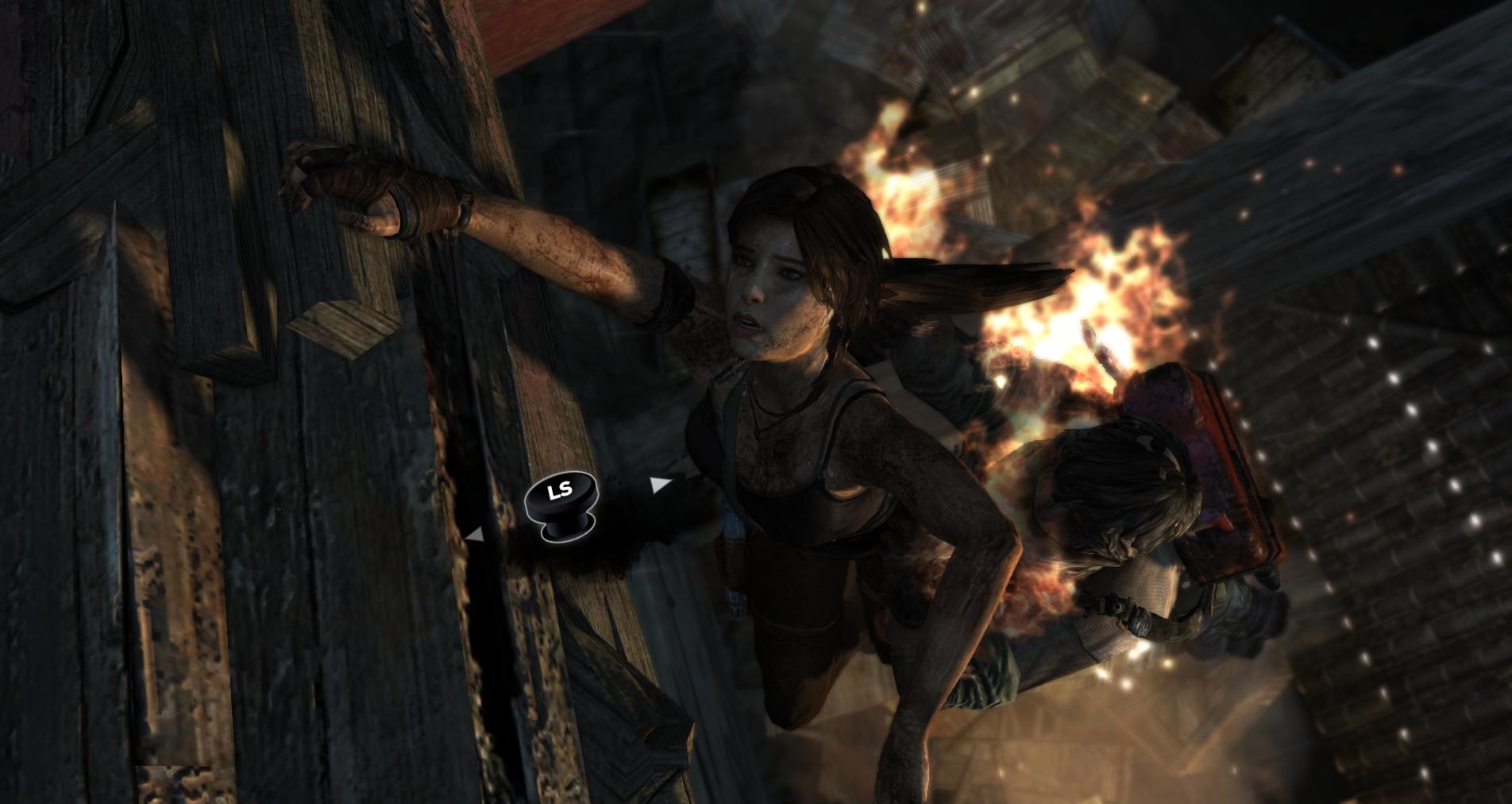
Failure scenes have become a separate art form. The new Tomb Raider sure has its share.

We've all had that one dream where something is attacking us and we can't do anything because it's a dream. In my case, I've dreamt that there's literally a snake in the grass in the front yard outside my house. I step into the grass, because it's a dream, the snake prowls around, lunges for me, end dream. I'm not particularly afraid of snakes, I guess I had recently watched or played something with snakes.

Then, one night, my dream changed. Same set-up, but this time when the snake lunged, time seemed to slow down and I saw a prompt for a dodge. The dream followed the prompt and allowed the snake to fall past me. The dream then prompted me to move in for a counter strike. I did, and, well, I can't really pull much more of the dream past that. Either way, waking up from that dream gave a very interesting feeling. My go-to dream for helplessness was completely turned around to be empowering. Because of video games? Because of quick time events?

Like I said before, quick time events are a reaction-based mechanic. They test your reflexes and hand-eye coordination by telling you a button to press and giving you little time to do so. Gamers typically have better association of buttons with functions than they do the labels of the buttons to their positions. I also mentioned how QTEs can be a gameplay translation of instinct. Instinct, which I define in simple terms as "being yourself quickly." That is, react as you would without taking time to revise in your head. It's empowering to know what to do and when. It helps you reaffirm your identity and proudly own it.

Heavy Rain, a PlayStation 3 title, was really ambitious with quick time events.

Video games always depict characters using instinct to save themselves or others from peril. In real life, ideally, peril is not ever-present. However, the opportunity to use our instincts is. For instance, I'm sure at some point in your life someone has approached you and said "hello." What did you do in return? Look at them and stare blankly while you decided between "hi," "hello," "good morning," or just a nod? Probably not. You picked a response and had a conversation. Your brain went through a little quick time event. Sure, nothing was at stake. Life would go on if you had said "apple," but all the same you were prompted and your instinct to greet the person back kicked in.

Saying "hello" isn't exactly the most intense example, but it is a relatable one. Real-life quick time events happen all the time. Some of them occurring in the form of decisions. Ever catch a ball that was flying straight toward you? Good job on that quick time event! Job seekers, have you ever seen a posting on craigslist that you qualify for but said "nah?" That was a quick time event that you willingly didn't respond to. The only difference is you won't come back to that moment to "get it right." This isn't guilt, just fact.

The fact that video game characters can respond to situations so quickly and expertly is why we see them as being strong. They don't second-guess what they're capable of, they just do what they can - or must. We too can be just like them. Sure, we won't be hitting any emergency brakes nor making jumps to safety, but we will be accomplishing commonplace feats that make us great people in our own home. Helping someone grab the milk on the high shelf, taking out the garbage, speaking up to volunteer, speaking up to not go through with something that you're being pressured into. All of these things which you may brush off or not feel "strong" enough to accomplish are more possible than you can imagine. It's not as simple as pushing a button, but it takes just as much effort when you set your mind to it.

Give it a try. See if, in your regular day, you can recognize a quick time event and do what you imagine it's prompting you to do. If you have any relatable experiences with real-life quick time events that you want to share, please post in any of the linked social media. I look forward to seeing responses. Until then, game out.

P.S.

I make quick time events out to be very promising, but in execution they actually have somewhat of a poor track record in gamer culture. See below for a humorous take.

Wednesday, March 13, 2013

Street Fighter IV and Owning Your Character


There's two things we know about Street Fighter character Guile for sure: His theme goes with anything and his advice to any person is that they "go home and be a family man!" Aside from these very memetic things, I wonder how much about Guile the common internet goer knows? Do they know his actual personality? His back story? His rank in the US air force? I'm sure that people who enjoy studying up on the Street Fighter mythos would know all that.

As for me, I actually did not care much for Guile. It's true. In my younger years, I COULD NOT fathom Guile's moveset. The core of Guile's special moves is the mechanic of holding the joystick in one direction, then quickly moving the other way and using an attack. For the life of me, I could not get that timing down. I guess I rather harbored those frustrated times and continued to overlook Guile for that reason.

In particular, the Flash Kick vexed me. Part of the command was 'up.' As in the same 'up' used in jumping!!

In my recent playing of Super Street Fighter IV: 3D Edition I made it a point to give every character a chance. When I played Guile, all that learned behavior came back. The natural aggression I learned playing Ken, Dudley, Rose, etc. clashed with the campy style that Guile promotes. One of Guile's strategies is to keep in a low blocking position so he can punish impatient opponents. Low block? Come on! This is Street Fighter! I want to go in fireballing and uppercutting! Granted I can now appreciate how intricate the fighting system is and how there IS more to it than quarter-circle-punching my way to victory... my stance on Guile hadn't changed.

In addition, I found Guile to be... well, kind of a jerk. In his win quotes, he tended to be condescending in that 'grown-up' way and put people down after winning over them. I guess that being a soldier, he feels a need to discourage others from combat and fighting and all that. Even so, I wasn't a fan.

A little later, my constant playing of the game lead me to take on a different sort of project. As part of that project, I needed to do a character study of Guile. Mind you, the reason I picked Guile was for his memetic qualities alone. All I really wanted was to get a feel for how he behaved in battle so I can build accurate fight scenes involving him. Naturally, the start of this was rather reluctant.

I got a feel for his martial arts in a narrative sense, but I was left wanting more from the gameplay perspective. Thus, I dedicated some time to practice and study.


In time, I got into it. My advanced gamer reflexes could now pull off the timing necessary for sonic booms and flash kicks. I learned the range of Guile's fierce attacks, doing sweeps to stall and charge a special move, and made it a game within a game to see if I can pull off Guile's Ultra attack, much more actually finish a match with it.

Suddenly, I was hyped for Guile. I was learning while I was mopping up and it was fun. I even took pride in his personal mannerisms like sunglasses, his dedication to his hair, and his occasionally ham-fisted demeanor. Because I lived this character, I internalized more his dedication to his mission and the merits of his patriotism. His attitude towards other fighters still left something to be desired, but I knew more than before that Guile was within his character to say those things. He wasn't particularly condescending... he was just Guile. Rather than accentuate the negative to support my aversion to the character, I looked for all the positive to see. After all, a character that I spent so much time learning can't be all that bad, right?


So... what happened here? I circled around Guile for half my life and didn't give him a second thought. Suddenly I gave him the benefit of a doubt and I'm an overnight family man? Not quite.

See, if Street Fighter came from and stuck to a non-interactive medium, say purely big/small screen franchise, I doubt I could have ever taken a shining to Guile. His no-nonsense personality was too abrasive for me. I would have supported him as a protagonist, but only that far. Expanding on his back story may give me more to judge him by, but the character we have here doesn't change much for it.

The video game angle is what caused this change in outlook. It's one thing to know where a character comes from, but it's another to actually BE that character. Having their skills at your disposal gives you a deeper insight into what it's like to be this character. Of course, we can't experience for ourselves the loss of Charlie or take on the strain of remaining a noble soldier while hatred plays your forced muse.

We CAN, however, slip ourselves into Guile's camo and wield his sonic boom. The more we learn a character and turn to them as an ambassador for the Street Fighter experience, the more influence this character can have on us. Suddenly, we are more sympathetic to Guile's mission. We are right there with him when he grips a fist in agony after a time-out loss. After Guile toasts to a temporary victory, speaking to his friend's tombstone, the word 'amen' may be on the tip of your tongue.

Then again, your experience owning a character in a tournament fighter probably isn't so dramatic or in-depth. At the very least, you'd echo a sound bite or mimic a mannerism when you're feeling particularly proud of a win over a real-life friend.


Movies, TV, books, etc. can do a lot to give you an in-depth look at a character. They can weave words and images, or make the character a consistent part of your life as you follow their journeys. Each medium has an advantage over the other to pull off the same narrative goal. Video games are distinct in that they are capable of saying, "You know what? Here. You take control and see what it's like." It's up to the game from there to use perspective, control, gameplay, scripted events, and much more at its disposal to tell its story.

Of course, not every game is an epic tale or descent into the very soul of its protagonist. Then again, what a game is or isn't depends entirely on the imagination of the gamer.

Tuesday, March 12, 2013

Portal and Inception


Yes, that Inception. Get out your mammoth horns and spinning tops, because we've got to go deeper. Toss in thinking with portals, and we've got today's topic.

As any Internet cynic will tell you, the term "inception" actually has nothing to do with dreams, much less the act of entering one. In fact, the movie dedicates a whole scene to establishing the true definition of the word. Simply put, inception just refers to the point in which something begins. In the case of the film Inception, this thing is an idea. The goal of the movie is to change a person by planting an idea in their head by going into his dream. The inception of this personality change is the point in which he sees this planted idea.

Are you following me so far? If not, that's okay. All you need to know is that in the movie Inception, the characters manipulated a person by planting an idea in his head without him knowing. When this idea came to his attention, he felt like he came to this idea all on his own. As a result, the idea feels like his own and he has no instinct to resist it. He doesn't feel like he's being told what to do. As I watched this movie and heard these concepts explained, I wondered why this felt so familiar. Naturally, my answer ended up being the same old: video games.

In particular, I thought of Valve's mega-popular and memetic Portal. You see, the goal in a typical game is to present challenges to the player and lead them to overcome those challenges. Therefore, the inception of victory will occur while the game is being played. Portal is a great example because the very structure of the game is to undergo this process of challenge, discovery, execution, and victory over and over and over and over again. Really, I could use any game that involves puzzles or strategy. Portal is just easier to talk about and more well-known.

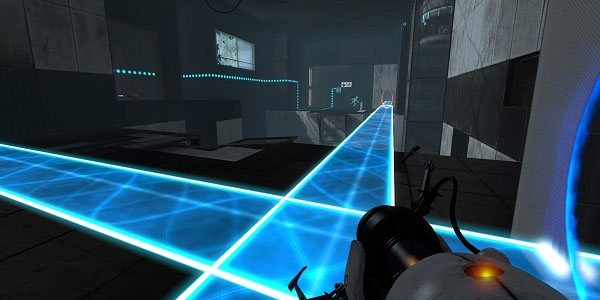
Your first experience with portals may be disorienting, but you'll get over it quickly.

In Portal, you play the role of a human "test subject" who must solve puzzles. The puzzles are solved when you manage to reach an elevator somewhere in a given room. This elevator is often placed out of reach and locked behind some door. You are armed only with  a portal gun and knowledge of how to use physics to your advantage. This portal gun literally shoots portals that you can set into walls, floor, and ceilings. You can only have two portals out at a time, colored orange and blue, and they only lead to each other. Thus, if you want to go somewhere far away, you can just shoot one portal ahead and one nearby. Walk through the nearby portal and you'll be wherever your further portal ended up.

This is all just the tip of the iceberg for Portal's complexity. However, it's enough information to pursue my topic. You can probably already see how Portal can be clever, even devious, with its puzzle designs. In any given puzzle, you already know all the information you need in order to solve it. Say, for instance, you need to place a block on a button in order to keep a door open. However, the block cannot reach the button. Then you may wonder: Since you can pass through portals, can you carry the block through with you? You can! You drop the block on the button and you're free to the elevator.

These moments of epiphany and triumph are common in Portal. You'll find yourself often saying, "Maybe I can... aha!" All it takes is for you to remember one little thing, try that little thing, and you come off with a great and revitalizing victory. Jane McGonigal refers to that feeling as a "fiero moment." "Fiero" is an Italian word loosely translating to "Pride." I suppose there's a cultural wiggle room there that allows us to define fiero also as a realization of one's own potential. The closest we have in the English language is the concept of not knowing one's own strength. But let's combine this with what we already talked about. You only came to this feeling because the game herded you to that victory by handing you everything you needed to succeed.

So, do we feel "played" by the game and its manipulation of our feelings? Or do we consider that our effort and problem-solving are still worth something? It doesn't help that the tests are overseen by a snarky AI who tries to mess with our head the entire way through. Well, it wouldn't be me if I didn't take the rosier approach. You still had to figure out your situation, you still had to make the most of your abilities, and you still had to execute the problem-solving. Sure, it's a video game, and problem-solving in a video game isn't exactly like real life, but that goes both ways. In real life, you might end up not prepared enough to solve a puzzle. On the other hand, a problem in real life might have several solutions, some of which easier and better for all involved. And to be honest, I'd rather feel prepared and wrong than in over my head and wrong. For all we know, "being prepared" can translate to one's ability to improvise. And you will be shocked at how well anyone can improvise.

The sequel adds even more complexity to the mix.

Now I'll turn it over to all of you. What stories do you have of great success and realization of your potential? This applies for in games and off. Successes outside of games, more importantly. If a success in a game can remind you of a success in real life, well, chalk that up as a game learning experience.

I really do hope that this discussion can help you rediscover something awesome about yourself. There needs to be more awesomeness going around the world. And if it does so happen that this post leads to some great revelation, you can thank inception for that. If you can't tell, I want to make the world a better place, one person at a time, starting with fans of games. If and when I accomplish this positive change, the inception of that change will be you reading these posts and being prompted to think on them. I've probably harmed my chances by admitting to it, but it's all for the sake of another point.

"Performing inception" is a real thing. It might not be as direct as in the film, but it happens any time anyone tries to be persuasive. The key is to be discreet, agreeable, and not have the other party feel like they're being told what to do. Think of one standout time that a game performed inception on you. Further, one time you may have performed inception on someone else. It's more common than you think.

I do apologize for the brevity of this particular post. I really did intend on just talking about Portal and Inception. My mind just goes wherever a deeper topic may present itself. In this case, talking about fiero moments. Look on the bright side, you got two posts today.

A discussion within a discussion.