Showing posts with label Wii. Show all posts

Wednesday, November 13, 2013

Wii Fit and a Spoonful of Sugar


It is the middle of November and by now people all over the world are exercising to their trial versions of Wii Fit U. I am one of them, which is good since I fell out from being consistent with the first Wii Fit. But I'm back on the Balance Board and things are looking up! I have already partaken in many of Wii Fit U's games and I am having actual real fun! And that fun is pivotal to today's topic.

"Wii Fit" is a household name to many, but for the uninitiated, Wii Fit is a game that gets the player to exercise. Since the game cannot provide physical feedback like standard exercise machines, it instead provides instructions and challenges that require the player to pose and move around in certain ways. For instance, Yoga exercises in a Wii Fit game show the player how to adopt a given Yoga position, then assess the player's ability based solely on how able he or she is able to maintain their balance on the Wii Balance Board. I could choose not to do the pose and stand comfortably so that the game would give me a favorable rating, but beating a video game wasn't exactly on my mind when I chose to buy Wii Fit.

Wii Fit U offers many yoga exercises, strength exercises, dance steps, balance games, and more, but what really got me inspired writing was my first experience with Wii Fit U's "Free Step" exercise. The activity is a simple one 1) Step on to the Wii Balance Board with one foot while raising the opposite arm and moving the other arm back. 2) Step on to the Wii Balance Board with the other foot while returning your arms to a neutral position. 3) Step off the Wii Balance Board with the first foot, this time raising the same-side arm and moving the opposite arm back. 4) Step off the Wii Balance Board with the second foot, returning your arms to a neutral position. It takes some getting used to, but Free Step gives you plenty of time to adjust. How much? Oh, in the area of a half-hour.

This deceptively simple screen has everything you need to step like a pro

If that last bit made you say "What!?" let me tell you my reaction was very much the same. When you start Free Step, you are given the option to quit at any time. You are also given the goal of completing over 2000 steps within that time. The game can work off of the Wii U's Gamepad so that your TV can be freed up for other things while you step through your half hour. Since my first playthrough of Wii Fit U was intended to just be a trial run to see what the game had to offer, I figured I'd do a good 100 steps and call it to see what else I could do.

So, I was off. The screen displayed a stage where my character and a bunch of my handmade Mii characters had their own Balance Boards. The onscreen character automatically did his steps, which was my prompt to imitate him to make sure I'm doing it correctly. The game even provides a helpful stepping sound effect to signal the moment when your moving foot should touch down each time. I took all of these into account and began my steps. The game only counts steps you actually do, and uses pressure on the Balance Board to verify those steps.

As I worked to imitate my character as close as possible, stay in step, and switch feet as smoothly as he did, 100 steps came and went. I don't know what it was, the step counter, the little Miis standing around supportive, the trainer's voice informing me of my progress, or just how little I looked at the ingame timer counting down from thirty minutes, but I was feeling pretty good. The steps weren't physically demanding at all, but I was still working up a good amount of effort. I was also getting bored, but in the best way. I got the idea of what to do and the steps were too slow. I then noticed that Free Step has three tempo settings and I had been stepping to the lowest one. It was time to get Wii Fit! I clicked onto the second setting, found it alright, then clicked onto the third setting. And then I was off for real.

As the minutes ticked down, the steps ticked up. With four steps in a cycle, it was 25 cycles for every 100 steps. At some point, the trainer even stops using specific numbers when telling you how many steps you've done. That's a good indication of when you're high up there! Over the half hour, I could move in tandem with my Mii on the screen and switch feet on the fly seamlessly. Pretty soon I was looking at the clock, but only to get an impression of how many more steps I could get out before the half hour was up. I was in a state of Zen that I was in no rush to leave. And yet, all good things come to an end. When the half hour was up, I had done well over 2600 steps and could feel them all in my thighs. And I still went for another 15 minutes on other games to round out the full hour of exercise.


Some of these games take crazy coordination. I love his enthusiasm!

Now, I consider myself middling at best when it comes to work ethic for exercise. Yet here I was putting in half an hour straight of steps. What happened? My friends, gaming happened. It's easy to feel negative about exercise if you haven't done it in a while, but it's even easier to feel positive about games, especially if you haven't played any in a while. Wii Fit U managed to take the eagerness I normally reserve for games and redirect it towards exercise. Whatever associations may be keeping me from exercising were rendered null in the face of my overwhelming love for games. You might say that the game "tricked" me into exercising, but I certainly don't feel tricked. And if it is fact that I was tricked, that's my kind of trick!

This experience taught me the importance of associations in human psychology. We as people can have very warped senses of priority based on previous experiences. This is where procrastination comes from, after all. I hear all the time about workers who have a report due the next day and they'll play five lives in Candy Crush before even looking at said report. It's not even a contest. It's also easy to understand how that happens. Candy Crush is fun, colorful, and gratifying. Comparatively, the report is arduous. Imagine if the worker could channel that eagerness from Candy Crush to that report. After all, that individual report needs to only be written once while Candy Crush will always be there.

And that's basically what happened with me on the Wii Fit U. I can't speak for everyone using the software, but I have gone on to incorporate more activities in my usual exercise routine and be more consistent with it. I may not have the benefit of a game tracking my progress, but the positive experiences I had with exercising filled in those gaps. I less thought about exercise as something strenuous and more like a cumulative activity that I am meant to improve and build on. Even if it were scientifically proven that exercise shouldn't be possible and fun, I am able to keep doing it as if it were. Thus, I was "tricked" not only into doing exercise, but enjoying it as well.

Two saying passes through my mind in response to this. One was "Give a man a fish and you feed him for a day. Teach a man to fish and you feed him for a lifetime." The other one was "A Spoonful of sugar helps the medicine go down." Though the first one is relevant, I believe my case with Wii Fit is more accurately described by the other. Many will recognize this quote as sung by Mary Poppins to motivate the Banks kids into cleaning up. Literally, the quote refers to the general bitterness of medicine and a child's unwillingness to take it, even if sick. But adding a spoonful of sugar will make the medicine taste appealing enough for the child to take. In context, Poppins is saying that menial tasks can be completed quickly and made fun if you don't think of them as menial and more gamelike. Sure, the film depicts "fun chores" as simply snapping one's fingers and watching the room clean itself, but clearly that is symbolic for how easy it is to clean one's room when you're having fun while doing it. At least that's how I choose to see it. And I digress.

Ms. Poppins explains it best herself

I would encourage official study into this topic of enriching non-game work ethic with game-like incentives, but that actually has been well underway for years. Many of you probably have been thinking the term "gamification" throughout this whole article, and you'll all be right. For a quick reference to what gamification is, I point you towards this early Extra Credits episode on the topic. Very good viewing. And as you can see from the video, gamification is still very early in its development and has incredible potential for growth, but it still represents everything I've been talking about throughout this article. In fact, you could say everything I've been writing about since March is a case-by-case argument for gamification's potential.

How about you? What experiences have you had with motivation in video games? What are some times where game-like thinking have helped push you along, or even been key to solving a problem? I have found that when I go into a game, I come into it with a sort of neutral optimism because I know the game was designed with my success in mind. This is an attitude that video games do in a way all to their own. I'm not even aware of this positive attitude, but I have brought it with me to non-game situations and been all the better for it. I'll bet every gamer also does this and has a great story from it.

Thank you for reading, and I'll see you in the Wii Fit U Gym Communities!

-

Email: RBAshkenazi@gmail.com
deviantART: http://captain-gamer.deviantart.com/
ScrewAttack: http://www.screwattack.com/user/captain-gamer
Tumblr: http://captaingamer.tumblr.com/
Twitter: https://twitter.com/Captain_Gamer
YouTube: http://www.youtube.com/user/GamerHangVideos

Thursday, August 1, 2013

Phoenix Wright and Focus


By now, my Nintendo 3DS is my preferred exercise companion on the treadmill. Sure, other devices offer similar services, but nothing captures my attention like a good Pokemon battle, RPG cutscene, flight around Wuhu Island, or courtroom drama. For today's topic, we will discuss why that last example is so effective.

We all can agree that the Phoenix Wright games really make us think. Capcom's law games create these little worlds of scenarios, character, evidence, and motivations. At its most intense, I have found myself so immersed in a Phoenix Wright storyline that I began seeing the real world in terms of alibis and some way in which a murder could have been hidden.

Officially known as the "Ace Attorney" series, some games in the franchise even star other characters and take place at various times in the world's history. Phoenix Wright just happens to be the most recognizable aspect of the series .

For the uninitiated, Ace Attorney games work your problem-solving skills more than they do your reflexes. You won't be defeating enemies one after the other, nor won't you be grinding up stats, picking up loot, earning weapons, or even much of controlling your characters. The bulk of Ace Attorney gameplay is in its dialogue. You will spend more time hearing characters talk and explain things than you will taking any sort of action.

Everything happens in menus, and every option opens up a colorful and endearing new event

On paper, this sounds dreadfully boring. But in execution, this is perhaps the most enthralling way to play a video game that I have yet experienced. Like I said above, an Ace Attorney game is more than interactive media. It is a window into a world of intrigue and murder mystery. And yes, every court case boils down to murder at some point.

Every chapter follows the same formula: Your main character meets a person who is charged with murder and takes the case to defend this person. From there, you hit the streets to scour the crime scene, find evidence, and talk to people related to the incident. The games are all very linear, so you'll be following a carefully crafted storyline the whole way through. When your investigation is over, it's time to head to court where you will engage in debate with the prosecutor, whose job it is to see your defendant found guilty.

Already you can see how Ace Attorney can keep a person hooked. The gameplay and the storyline are chained at the hip. Whereas most of what happens in a video game is part of the "experience" and you can go for long stretches without continuing the story, Ace Attorney is in storyline mode full-tilt. If the game ever stops, it's because it needs you to nudge it in the right direction. You are never not ingrained in an Ace Attorney storyline for as long as you are playing it.

By now you're probably wondering what it is the player actually does which presents any challenge. Well, there come times in the story where your protagonist will have to put money to mouth and prove their point with some evidence. But they won't do it by themselves. When you hit that impasse, it's up to you, the player, to sift through the evidence and find that piece that will throw doubt on the other person's claims, forcing them to elaborate or admit to lying. So, if your witness claims to have never been at the crime scene and yet you found their phone right next to the body, time to raise an OBJECTION!! Digging up the truth is very rewarding, and watching your character pursue that line of logic further just makes it all the better.

 But allegedly, the victim wrote the defendant's name with his right hand. Curious...

Bringing it all together, what does this game being good have to do with me being on the treadmill? Nothing, directly. But it does help me focus on the exercise. And funny enough, it helps me focus by taking my mind all the exercise almost entirely. And let me say ahead of time that this is a particular sort of multitasking that not everybody can do, so be careful if you try it out.

First, by concentrating on the game I am less aware of my surroundings. Not by a whole lot, just enough to where I am not constantly checking the clock, calories, or distance. This way, I won't be thinking about how much further I need to go. Likewise, since I'm not focused on the strain of the exercise, I won't have any reason to exaggerate how tired I feel just to give myself a reason to cut it short.

Second, the attention that I am not giving to the exercise pours straight into the game. With the amount of attention that game commands, it's not likely to let go of that focus any time soon. The storyline is constantly in motion, so at any time you can just click on it to see more. Further, the conversations and characters are entertaining enough where pretty much any exchange contains at least one smirk or laugh out of the player. There is a lot going on at any time in the game, so you'll be thinking about the storyline and what the newest developments mean for the larger mystery afoot. Even putting the game down to think about something will keep you invested enough to where you won't get bored while exercising.


The game's music is also exceptional and has everything to do with the Ace Attorney experience. The iconic "Cornered" theme is catchy, especially in a capella.

There are two caveats for this method. First, playing a game while exercising requires being able to multitask in a very particular way. While I can stay enthralled in my game, I still need to keep up with the treadmill, maintain balance on the belt, and keep an eye on the timer so I can scale up the speed according to my routine. If you cannot multitask like this, then this whole method could prove dangerous. Practice first on low speeds, even if you already multitask well.

Second, there do come those times in an Ace Attorney game where you will get utterly stumped. The solution is out there, but your thought process won't find it. In those cases, the game's hold can wane. In that case, you may want to switch up for a game that doesn't require problem-solving to continue, like Animal Crossing.

These things aside, I have a great time on the treadmill with 3DS games, Ace Attorney in particular. If the story really picks up, I might even pull some overtime just to keep in the zone.

All of that said, I'd like to hear from you. What activities keep you in "the zone" like a good game does? Which activity would you like to have a zone for? A game-like perspective on that activity may help in accomplishing this. On the other side, what are good games you like to play while doing something else? And on the other side of the other side, what are some things you like to do while playing games? I know I like to wind down at the end of the day by catching up on my videos while playing some Borderlands 2 or Cube World. I look forward to seeing what you all have to say! Until then, game out.

Tuesday, April 9, 2013

The Skylanders Mom and Gamer Networking


Given some time, shopping for video games with one's parents is going to become one of those essential childhood memories. I know that I cherish such memories. During my own trips to video game retail stores, I occasionally get  a glimpse into what the whole process is like nowadays. I've seen all sorts of experiences, ranging from the nagging kid whose parent buys a game based off a cartoon, to the encouraging parent purchasing the latest Mario for their grateful child. But sometimes, you see something different.

Browsing in the Electronics section one time, I overhear a mother and son in the Skylanders toys. For the uninitiated, Skylanders is an action/adventure series of games which contains a huge library of playable characters. You gain the ability to play as new characters by purchasing the action figure of that character and using a peripheral to plug the character in the game.

In the store, I actually saw in passing the son placing an action figure on the demo booth to see the character in action. He was seriously deliberating. Eventually, he goes to his mother and says he chose that character. And this is where it gets interesting. The mother takes one look at the character and says, "This looks like a big guy. Don't you play the fast guys?" to which the son responds that he wants to try a slow-but-strong character for once. They went back and forth for a bit, including one time when the kid tried a big character at a friend's house and said he didn't like it, leading to the kid saying he wanted to actually take it seriously.

What struck me about this exchange is that the mother and son were genuinely discussing strategy and logistics about the game. Normally, we'd come to expect the mother to sigh "okay," drop the toy in, and be on with her day. But here, she actually took the purchase seriously and wanted to talk it through first. Not as the credit card-holder trying to stave off a purchase, but as someone who understands what the purchase means to the child. She knew enough about the game to talk about it on the same terms as her child.

Every character in Skylanders comes with its own unique stat spread.


I was floored to hear this. I don't know if this is increasingly common now, but during my youth parents did not try to understand video games. The norm was that video games were not something that required further understanding. They were in the same league as simple toys. It's funny I say this so firmly because one of my parents was a subversion of this norm. My mother, much like the Skylanders mom, actually stopped to look at what I was playing and rationalize the bright colors on the screen. She knew what "characters" meant to video games. She understood what a "hit point" was. She saw how to recognize who the player character was without needing me to tell her. She knew what a power-up was and could alert me to when one pops onscreen.

Hearing the Skylanders talk made me think about a discussion I had before where I tried to make the argument that video games are just as complex and conversation-worthy as any real-world sport. Naturally, the other person had all of popular culture on their side and I had to concede. In light of overhearing this conversation, I'm thinking popular opinion is starting to sway the other direction. Now that video games are on the popular culture radar, my argument for the complexity of games has more ground to stand on.

Lastly, and just as importantly, even I could understand the conversation I was overhearing. Not because I've played Skylanders, but because I've played games in general. Games have a lot of things in common. In this case, the kid was used to characters that moved fast but could not defeat enemies quickly. This new character would move slow, but defeat enemies with less hits. He is swapping out the advantage of speed for the advantage of power and perhaps other capabilities.

Fighting games, by far, most emphasize the differences between characters and topics of discussion.

Thinking on that last point, I have come up with a term for how general video game knowledge allows someone to understand a game they haven't played yet. "Gamer networking" is what I've come up with so far. That is, networking with an emphasis on video games. In this day and age, "networking" mostly refers to a person socially engaging others to build a "network" of friends and acquaintances. People often network by emphasizing things they have in common, such as what movies they like, sports they follow, what they do for a living, and so on. This way a person can have a big network to be well-connected in many places among many types of people.

Gamer networking is interesting because video games are so complex. There are entire genres of games, and each game in each genre can be radically different from each other. And yet, video games all come from the same roots and therefore contain a lot of similarities as well. For instance, Final Fantasy is a very different game from Bioshock. However, both games have in common that the players attack enemies in order to win. In both games, the damage that players deal to enemies is quantified. In both games, the amount of damage can be increased in some way. In both games, the benefit of increasing attack power is taking less time to defeat regular enemies and being able to keep up with the more difficult encounters. Therefore, if a player of either of these games mentions a time for opportunity in which they increase their attack power, the other will know right away the basic benefits of that increase. And yes, players of both of these games will be able to join a conversation on using heavy characters in Skylanders.

Gamer networking is not just for people who freely identify as gamers. People who network over sports have discussions of a very similar sort. And then there's the fact that non-gamers have stormed the scene as casual and social gaming grow. Let's take one of the most prolific games of the modern era, one that every person reading this blog has either played, played secondhand, or heard about. Yes, folks, even players of Angry Birds can get in on the action. Angry Birds is a game more different from Skylanders, Final Fantasy, and Bioshock from each other, yet the concept of "more power" exists there as well.

Though Angry Birds does not emphasize defeating enemies, you still use force to knock down buildings using your birds. The individual birds cannot power-up, but using special birds is satisfying and mostly essential for getting the best results on stages. The Big Brother Bird in particular goes along with my point because it is a straight upgrade from the standard red bird character. It may not be as precise as the red bird, but precision is less of a factor when your bird can just demolish whatever it touches. It's not exactly the sort of quantified power in the other examples, but it is a relative increase in power all the same. Kind of a stretch, but the connection is there.

Just watch the first minute to see the big guy tear it up.

You see, the more you break down a video game into relatable problem-solving tasks, the more easily someone can understand it. The less a person knows about games, the simpler you'll have to get. Getting someone on your level requires effort and patience, but it is worth it. I've had long conversations with people who have no prior interest in games but every good intention to understand what they can, and all because I worked my way up.

It seems that we as gamers also have the progress of technology on our side. The more people come to rely on bright screens and dealing with user interfaces, the less foreign video games feel. In fact, video games may turn around and help us in the real world of situational awareness and problem solving; but that's a topic for another time. Either way, the Skylanders mom provided a good window into what could be when it comes to public knowledge and attitude surrounding video games. Perhaps in the future, more complex games will work its way into global culture; and not just a split-second of Call of Duty or an offhand app reference.

So, what about you? What experiences have you had in gamer networking? Ever tried explaining a game to your parents? Invited your friends over for some game time and had some banter? Or maybe you've butt heads with another game online about the superiority of one character or another. I know we've all done it, and I want to hear it. Until then, game out.

Thursday, March 21, 2013

Quick Time Events and the Subconscious


The laugh track. The sound board. The wide-angle lens. As media evolves, it develops new techniques. Either because of advances in technology, or simply because an idea sees great success and becomes a trend. Video games have seen plenty of its own techniques as the time has passed. One of the more divisive techniques of the modern school of gaming is the quick time event.

For the uninitiated, a quick time event (QTE) is a gameplay mechanic in which the game prompts the player to press a specific button to achieve a certain goal. This is different from regular gameplay in that these button-presses are context sensitive. Where the A button normally makes you jump, in a QTE you'll be prompted to press the A button to have your character jump out of the way of a falling rock. QTEs are characterized by being reaction-based and generally trying to give a gameplay translation for a character's instincts.

I can trace the evolution of the quick time event in three landmark games. The first game is Shenmue, released for the Dreamcast in 1999. During the course of the game, main character Ryo Hazuki is put in several situations where he must avoid something, catch something, or give chase to someone. In particular, the chase scenes involved Ryo dodging obstacles and choosing paths. For the cinematic effect, regular gameplay was probably not intricate enough or too awkward. Thus, the scene was depicted as a cutscene with quick time events as input. The scene changed depending on the player's success with the quick time events. Shenmue implemented QTEs so effectively that it put the concept on the map for future games to build on.

The Wii literally shook things up by incorporating motion controls.

The next game in my analysis is Resident Evil 4. Aside from forging new ground in third-person shooter games, I find this game incorporated quick time events not unlike Shenmue. In fact, Resident Evil 4 used them more frequently and in different ways. A cutscene would play for minutes, when all of a sudden the A button would appear onscreen. In the case of Resident Evil 4, failing a QTE would almost always result in a gruesome death for protagonist Leon Kennedy. Perhaps someday I'll revisit the concept of those death scenes in another post. QTEs also appeared in non-scripted situations, such as when an enemy grabbed Leon. This actually is a step up from a Resident Evil 3 mechanic which allowed the player to move in the opposite direction of an enemy and avoid damage. This is shown by having Jill Valentine execute a dodge ability.

The last game that I think leads up to quick time events as they are today is Dead Space. Dead Space, or at least my interpretation of it, is a game that aims to one-up everything about Resident Evil 4. The running and gunning was smoother, the environments were much more immersive, and the death scenes were even gorier. Once again, I'll come back to that sometime. And yes, Dead Space incorporated quick time events in similar ways. In fact, Dead Space took it a step further. Dead Space set up "scripted events" which required QTEs and other context-sensitive actions to progress. For instance, upon entering a certain corridor, the game is programmed to have a large tentacle monster grab Isaac Clarke and drag him to a hole. The player had to shoot the monster's weak point to save Isaac. However, the fixed camera made this difficult.

So what am I getting at here? Games like Dead Space, Resident Evil 4, and Shenmue have a sort of "pace" to playing them. Quick time and scripted events are part of the experience and the brand of these games. There are normalcy and consistency in these mechanics. Well, I've had an experience that told me there's more to this.

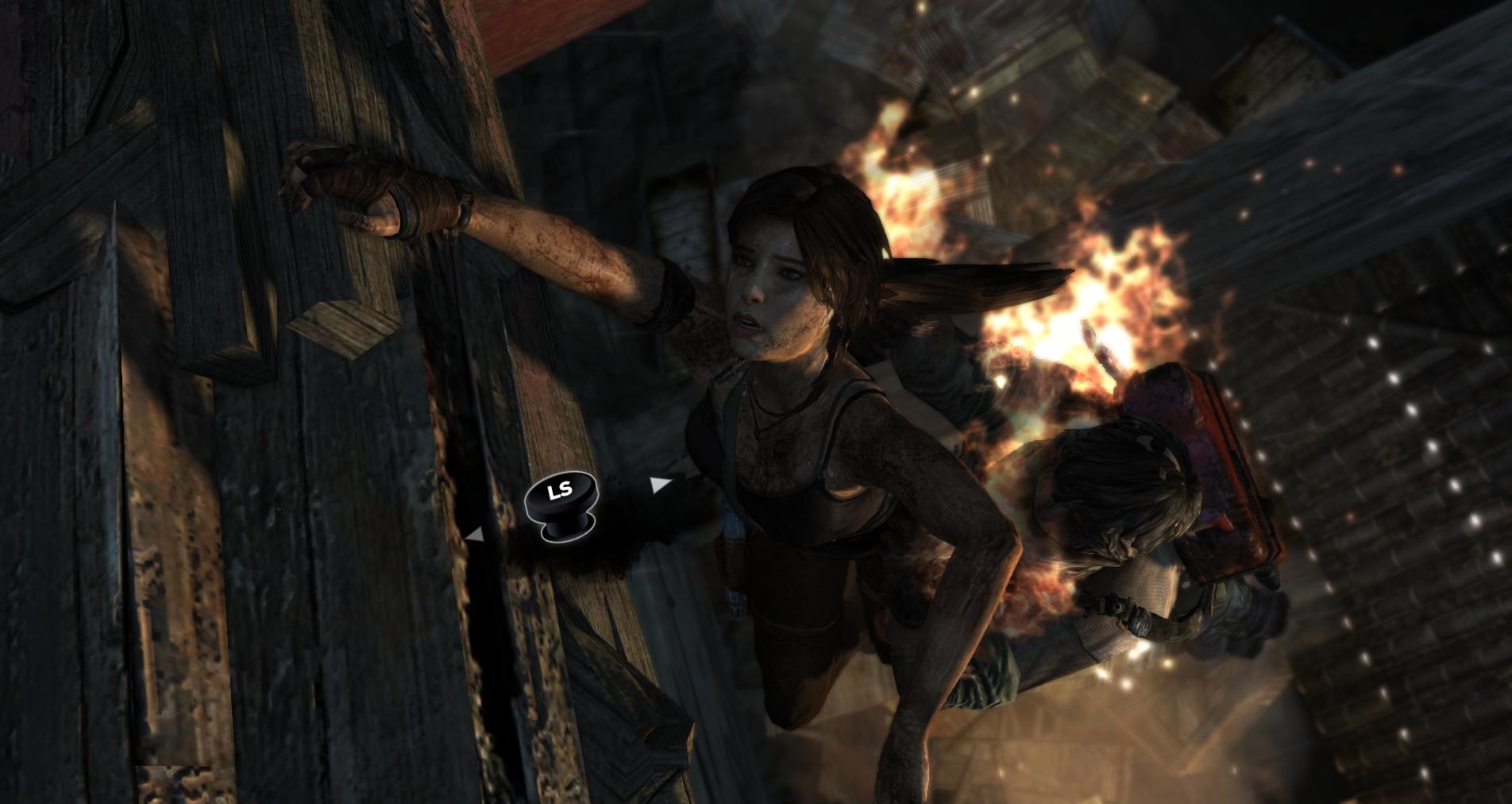
Failure scenes have become a separate art form. The new Tomb Raider sure has its share.

We've all had that one dream where something is attacking us and we can't do anything because it's a dream. In my case, I've dreamt that there's literally a snake in the grass in the front yard outside my house. I step into the grass, because it's a dream, the snake prowls around, lunges for me, end dream. I'm not particularly afraid of snakes, I guess I had recently watched or played something with snakes.

Then, one night, my dream changed. Same set-up, but this time when the snake lunged, time seemed to slow down and I saw a prompt for a dodge. The dream followed the prompt and allowed the snake to fall past me. The dream then prompted me to move in for a counter strike. I did, and, well, I can't really pull much more of the dream past that. Either way, waking up from that dream gave a very interesting feeling. My go-to dream for helplessness was completely turned around to be empowering. Because of video games? Because of quick time events?

Like I said before, quick time events are a reaction-based mechanic. They test your reflexes and hand-eye coordination by telling you a button to press and giving you little time to do so. Gamers typically have better association of buttons with functions than they do the labels of the buttons to their positions. I also mentioned how QTEs can be a gameplay translation of instinct. Instinct, which I define in simple terms as "being yourself quickly." That is, react as you would without taking time to revise in your head. It's empowering to know what to do and when. It helps you reaffirm your identity and proudly own it.

Heavy Rain, a PlayStation 3 title, was really ambitious with quick time events.

Video games always depict characters using instinct to save themselves or others from peril. In real life, ideally, peril is not ever-present. However, the opportunity to use our instincts is. For instance, I'm sure at some point in your life someone has approached you and said "hello." What did you do in return? Look at them and stare blankly while you decided between "hi," "hello," "good morning," or just a nod? Probably not. You picked a response and had a conversation. Your brain went through a little quick time event. Sure, nothing was at stake. Life would go on if you had said "apple," but all the same you were prompted and your instinct to greet the person back kicked in.

Saying "hello" isn't exactly the most intense example, but it is a relatable one. Real-life quick time events happen all the time. Some of them occurring in the form of decisions. Ever catch a ball that was flying straight toward you? Good job on that quick time event! Job seekers, have you ever seen a posting on craigslist that you qualify for but said "nah?" That was a quick time event that you willingly didn't respond to. The only difference is you won't come back to that moment to "get it right." This isn't guilt, just fact.

The fact that video game characters can respond to situations so quickly and expertly is why we see them as being strong. They don't second-guess what they're capable of, they just do what they can - or must. We too can be just like them. Sure, we won't be hitting any emergency brakes nor making jumps to safety, but we will be accomplishing commonplace feats that make us great people in our own home. Helping someone grab the milk on the high shelf, taking out the garbage, speaking up to volunteer, speaking up to not go through with something that you're being pressured into. All of these things which you may brush off or not feel "strong" enough to accomplish are more possible than you can imagine. It's not as simple as pushing a button, but it takes just as much effort when you set your mind to it.

Give it a try. See if, in your regular day, you can recognize a quick time event and do what you imagine it's prompting you to do. If you have any relatable experiences with real-life quick time events that you want to share, please post in any of the linked social media. I look forward to seeing responses. Until then, game out.

P.S.

I make quick time events out to be very promising, but in execution they actually have somewhat of a poor track record in gamer culture. See below for a humorous take.

Friday, March 1, 2013

Rock Band and Rising to Challenges


A while back I attended a birthday party. One of the activities going on in that party was a game of Rock Band. I spectated, one thing lead to another, and I ended up with a guitar. I have not extensively played Rock Band or Guitar Hero or anything like that. I get the concept and know the controls, but I've never really gotten into any of it. I figured hey, it would be good for a bit of fun.

I was instructed to play Bass on Easy or Medium. Since I was among a rowdy bunch on a birthday night, I knew it had to be Medium. After all, people were showing off on the drums so I figured I'd help feed into that sense of bravado.

For the uninitiated, most guitar games work by having you flick a switch with one hand while holding down one or more colored buttons with your other hand. You can press the colored buttons all you want as long as you have the right one pressed and you strum as prompted by the game.

When I first got up there, I had my fingers on each button and figured my hand-eye coordination was good enough to use all four digits when necessary. It worked out just fine at first, but as the song got faster and more complicated, a sense of panic set in. I found myself abandoning use of my pinkie because I was the most confident in my middle three.

This lent itself to some problems. With four buttons and three fingers, I was okay until the game called for the button I was not covering. I had to quickly adjust my grip to cover the three buttons that included the one I wasn't before. As a result, I kept on bumping from one end to the other, covering either the first three buttons or the last three. I did well enough, coming out with 90% or over, but I still desired more out of my performance. This shifting didn't feel right.

People, I have noticed, have varying reactions to challenge. On one end, people can lock up or self-sabotage in the face of challenge. This way, they take all the unknown out of a situation and ensure failure. All pressure is off and the person in question can just coast into the inevitable.

On the other end, a person may see a challenge and shed their inhibitions. Not ALL inhibitions, just the ones related to completing said challenge. When that happens, the person focuses not on the results of attempting the challenge but rather the actual process of making that attempt. And if all you're thinking about is what you have to do, you won't be hung up on any what-ifs since that would thinking too far forward.

In my case, the first few songs gave me enough practice to develop muscle memory. Said muscle memory was like a fun new tool for me to use in my quest for Rock Band stardom. I wanted to use and improve on this muscle memory so I could keep getting those warm feelings of intuitive play. The actual play became more important to me than whatever results I came away with. And wouldn't you know it, my performance improved anyway.

Once I was comfortable with the Rock Band flow, I was able to bring my pinkie back into the game. I now had full coverage of all the buttons. I no longer had to choke up and down on the guitar and remember where my fingers were now positioned. I could just press down and be done with it. I finally felt like I was doing it right. I had fun, even when I tried a few on Hard mode and utterly tanked.

It felt really good to challenge myself, rise to that challenge, and come off more skilled and confident because of doing so. This rings true to everyone. We have all been challenged by games and overcome them by wanting it enough. We learn what we're up against, we understand what we have at our disposal, and we really apply ourselves to combine our capability and our knowledge to come out on top.

Now how great would it be if we could call on that determination and give such an effort for other things in life? I'm talking about the job seeker, the promotion-earner, the would-be romantic, the test-taker, prospective parent. You might think it isn't the same since video games are programmed for success to be a viable outcome. Well, I'm here to say that real life isn't that much different. Succeeding outside of a video game similarly requires you to assess what you can do and to be honest about the challenge you face. Understanding what you're up against and seeing yourself rise to face it is a universal concept, not just for gaming.

That said, I now leave it all on you. The next time you see a challenge in your way, putting on your game face just give you the drive and motivation to see it through.