Showing posts with label Platformer. Show all posts

Thursday, May 15, 2014

Mirror's Edge and Cultural Synergy


Last year I saw a video featuring "Mirror's Edge-inspired parkour" and that got me thinking about that game. Time and time again, I have seen the name of Mirror's Edge pop up front and center whenever anybody talks about parkour in video games. If there's a discussion about freerunning in video games, Mirror's Edge will come up. If ever a game is modified to be more based around freerunning, that modification will often be labeled "Mirror's Edge-inspired." Parkour enthusiasts have rallied behind this game and adopted its art style as a symbol of the freerunning culture. What's the big deal? Last week I started up the game to find out.

For the uninitiated, Mirror's Edge is an action platforming game focused heavily on navigating through the world. The player character is armed only with a set of freerunning skills inspired by the acrobatic art of parkour. Instead of going down a beaten path, the player must climb to higher ground, leap across rooftops, run across walls, and generally use the urban terrain in any and every way to get from point A to point B. One aspect of the game that assists players is a mechanic called "Runner Vision," which represents the character's intuition for pathfinding. In the game, Runner Vision turns certain objects and platforms red to present a possible path or escape route. This often clashes highly with the game's normal pristine white environments and is part of the game's signature design.

The story introduces us to a dystopian city where the rich and powerful wield absolute control through coercion and surveillance. Any dissent is quickly put down. The only hope for any resistance is in a breed of athletic couriers called runners. The runners are the backbone of an information network that gives freedom fighters a chance. The player takes on the role of Faith Connors, a runner tasked with saving her sister's life and uncovering the truth of the ominous "Project Icarus."

Between chapters the story is told through more stylized animated cutscenes which have a bit of a noir feel

And let me tell you, this game is a wild ride all the way through. One moment you'll be freely leaping between rooftops. The next, you'll be running for your life from gunfire. The next, you'll find yourself indoors and needing to find your way up to an air vent. The next, chasing after a suspicious character who has information you need. Because the terrain is so important to how you progress, I can look at any set piece from this game and remember what it was like to find my way through it.

If you can't tell by now, I ended up liking the game. I'm not a parkour enthusiast myself, but watching their work and playing this game has clued me in to how they can swear by it and admit it into their culture. In fact, what I've observed researching this game rings true for many instances of video games based off of real-world cultures, hobbies, professions, etc.

First of all, Mirror's Edge is spot-on when it comes to simulating parkour with video game controls and a first-person perspective. Even if it's not perfect, you can tell a lot of effort and observation went into this game, and I think that's what really matters. There are plenty of games that feature characters that run and jump and navigate structures to get to their goals, but Mirror's Edge is one of the few first-person games that places it front and center. Barring moments when you may get stuck in a combat situation, you'll be running around and navigating terrain. In fact, the best idea when faced with enemies oftentimes is to find a route around and avoid them. You are encouraged to stay in motion and keep this about the freerunning, which is admirable.

You'll be seeing this view often as you tackle the game's many daunting jumps

It's worth mentioning that there is a rather neat combat system that incorporates your parkour skills, along with a gunplay aspect. Apparently the game's handling of guns leaves much to be desired, but I never bothered. And that's saying more about the athletic fisticuffs; I was having too much fun disarming opponents with well-timed counters and jump-kicking singled-out targets!

And that's the thing about video games which makes it exciting when there is one made based off of a real-life interest. A game can be as grounded in realism as much or as little the designers want it to be. Just because a game is realistic in some ways doesn't mean it can't be exaggerated in other ways for the sake of an enjoyable playing experience. In Mirror's Edge, failing a jump can cause you damage or kill you. If you take a jump slowly or from the wrong angle, it will take you more time to recover from it. If you approach the jump at the right angle while running at top speed, you can leap over obstacles and pull yourself up to higher ground faster. Those make sense because you're able to build up momentum and from a game standpoint you're rewarded for moving efficiently. Meanwhile, Faith always has perfect balance, never fails a saving roll after a high jump, and is generally never subjected to little unavoidable human errors that often lead to injury. Case in point, someone I know is learning parkour and he once hit his head on the ground practicing a standard rolling procedure. Faith will never do that. When you tell her to roll, she rolls and that's that.

The point I'm getting at is how there is some element of homage whenever a real-world interest inspires the mechanics of a video game. I can imagine there's something flattering to parkour enthusiasts about a video game in which the player saves the day with "the power of parkour," so to speak. Faith's freerunning skills are an exaggeration of real-life capabilities to present a flattering and entertaining image of parkour that can be enjoyed by everyone, enthusiast or non.


Here is the video that inspired this discussion. I believe the performer is intentionally emulating the feel of the game, which is really cool

In addition, by appearing as the protagonist and player character of this game, Faith has established herself as an icon of sorts. When a video game studio got the idea to make a game with parkour as a central mechanic, this character was created. Her being fictionalized and designed to represent an art serves to make her easier to rally around. Her look, her attire, her affinity for colors, became synonymous with her and the culture she was made to represent. There's some back and forth homage and inspiration at work. As a result of this character's creation and use in the game, parkour practitioners who are fans of the game seem to enjoy adopting those traits. For instance the runner symbol, the color motif of crimson against pristine white, and Faith's attire. I know of at least one video where Faith's signature red glove is prominent.

Having a real-life interest given the "video game treatment" can be an exciting thing. It represents the interest in new ways that can generate more interest from unlikely sources. The video game can then be used as a bridge between long-time practitioners and people who became curious because of the video game. On the other end, the interests represented can return the excitement back by representing the game in their real life practices. They can rally behind a common icon, that being the game, game world, or significant characters. There are a great many games that have been inspired by real world practices and had potential to enhance both. I'll quickly list a few others that may not be on the level of Mirror's Edge, but still show the creativity of video games as a medium.

Punch-Out!! is a very simple game, but it makes us all feel like heavyweights

One early example of video games taking inspiration from real life: Punch-Out!! for the Nintendo Entertainment System. This game plays more like an action puzzle game than it does a fully robust boxing simulator. The game misses out of the little nuances of boxing strategy that I cannot begin to comprehend in favor of reaction-based gameplay and pattern memorization. In the end, we still have a go-to video game for fictionalized and exaggerated boxing and all the fun that goes with it. I recall that the Wii installment in the series was met with great enthusiasm by a YouTube video creator who was big into boxing. The protagonist, the Rocky-inspired Little Mac, has come into his own as a boxing representative that gaming can call its own. And if these games have provoked any solitary individual into looking at real boxing, that aspect has also been fulfilled.

Ace Attorney is not a close law simulator, but it is a celebration of logic and situational awareness

Another noteworthy example: The Ace Attorney series known mostly for its protagonist Phoenix Wright. Ace Attorney hardly represents the legal process. In fact, it's more of a melodramatic detective series that boils down to proving clients' innocence in murder trials. But the characters, design, and stories are all their own while still inspired by the legal system. While we won't see Phoenix design contracts, settle out of court, or brush up on changes in law, one basic and key element is still represented: Logic. Phoenix still uses logic and his knowledge of the situation to reach conclusions which are both favorable and feasible. Though logic and the ability to see the bigger picture are small parts of being a lawyer, they're still vital, and Ace Attorney hits that note. At least I'd hope so. I haven't studied law, so I'm at the mercy of actual practitioners.

Confession time: I genuinely was a little bit obsessed with farming after first playing a Harvest Moon game

Last on my abridged list: Harvest Moon. Who would have thought a game about farming would be so popular and spawn a series that is still ongoing in more than one line of games? Clearly the designers, who started with the concept of a farming game and made it into a money-making game fueled by consistent small tasks. The amount of time it takes to grow crops and mature livestock is exaggeratedly quick, but the principles of day-to-day hard work are well represented. I'm not so sure Harvest Moon will make many farmers out of gamers, but teaching the work ethic of farmers still counts for a lot.

How about you? What are your noteworthy games inspired by real-world interests, hobbies, sports, professions, cultures, etc.? What fictional characters have you come to enjoy as a symbol of said culture? Or how has a game sparked any interest in a real-world practice? I want to hear from you.

Friday, May 2, 2014

Sly Cooper and M Plus One


I spent one magical week buried deep in Sly Cooper and the Thievius Raccoonus. I voraciously tore through the game's story and worked myself to the limit to clear the game's extra challenges. When I beat the game fully, I was rewarded with developer commentary unlocked for each stage. Whatever possessed me, I decided to take a listen. The Journey I took through Sly's development only made me appreciate the game all the more and introduced me to a fascinating concept: "M plus one."

For the uninitiated, Sly Cooper and the Thievius Raccoonus is a platforming game that challenges the player to win through stealth rather than combat. You play the role of the titular Sly Cooper, infamous thief, as he slinks, jumps, and swings around a wild variety of creative and stylish stages. In this game, the equally titular Thievius Raccoonus, a book containing the secrets of the Cooper family, has been stolen and separated page-by-page all over the world. Sly - and you - must use his family's legacy of skills and know-how to recover the pages, reassemble the heirloom, and thwart the ambitions of the villainous guilty party.

And I repeat, this is a stealth game. You are given a complex, hallway, building, etc. and your goal is to reach your target without being seen. All of the stages have tight security, so you'll be sneaking through the shadows, above everyone's heads, and taking shortcuts that keep you out of plain sight.  Therefore the environment design is very important not only to this game's presentation, but how it plays. Every power line, window, rail and pole is free game for getting around. And don't think this is all optional, because being caught or trying to engage an enemy head-on is recipe for disaster. You are a capable fighter able to single out targets, but you won't last long in a really hot area. Besides, it just feels cool to take secret paths and leap around rafters in a borderline parkour fashion.

You'll want to stay up and above this guard

I came for the story, the characters, the setting and the gameplay, and I stayed for the time trial challenges. Beating levels unlocks challenge versions of those stages. They aren't any different, but you'll be racing a strict timer. Beat the timer, and you beat the challenge. Beat the challenge, like I said above, and developer commentary is added to the game. And this isn't simply audio that you hear in a menu. The game actually places an object at the beginning of each stage that begins the audio log. If you're so inclined, you can play through the stage while the audio is playing. You can play the game and learn about the development process at the same time!

I essentially played the game three times. One for story, two for challenges, and third for the commentary. I am a complete sucker for any behind-the-scenes look at game creation, so I had no problem coasting through a third time with a developer talking in the background. Every stage had something new to note. The developer would talk about designing stages, character, enemies, the world, the story, and the gameplay. I distinctly remember one stage where the developer talked about how a stage's lighting worked for style and visibility. Sure enough, I looked around at the stage while I was hearing about the lighting and could absolutely see what the developer was talking about.

One topic that came up in the commentary was a concept called "M plus one." As described by the developer, M plus one is the design practice of introducing new concepts into the game and training the player to be proficient in those new concepts. "M" stands for "mechanic," and the "plus one" stands for the way which the game will gradually make the concept more challenging. This way, it forces the player to get better at that concept and prepare them for the puzzles and bosses ahead.

This game also has collectibles, colorful characters, great design, and more. I could go on but I can only fit so much in an article

Let's look at Sly Cooper and the Thievius Raccoonus as an example. If you want to get onto a higher platform, you jump to gain that height. However you can also jump to cross over gaps that you can't run over. Meanwhile, Sly has a cane that he uses in combat and as a way to operate levers. There are also poles that Sly can use his cane on to swing from and cross larger gaps. Now imagine instead of a gap, you're leaping off the side of a cliff and trying to land on a platform that is moving. See how M plus one works? You have these simple concepts, you hone them through a series of challenges, and then you combine these concepts to make all-new challenges that still fit with what you know about the game and the world.

Hearing it plainly like that is one thing, but where and when they place the commentary for their explanation could not be more perfect. You see, the explanation of M plus one comes relatively late in the game, when we've already had experience learning concepts and combining them without a name for it. In comes this developer talking about M plus one. At this point I am exploring around a casino-like stage while the developer rattles off examples of M plus one. And I kid you not, he talked about what I was doing at that exact moment.

In the casino stage, I was jumping between platforms. The platforms were actually large roulette tables, and they were spinning. This made it a little more difficult to jump properly since the very ground beneath me was moving me around. At the same time, there were bars of electricity that I had to jump over. When the roulettes weren't trying to spin me into those bars, they were spinning in the opposite direction of where I was trying to go so I would have a more difficult time jumping over the electricity! And right when I am dealing with this situation, the developer is talking about that very stage that I'm playing, that very obstacle I'm up against. I felt a connection with the developers at that moment. It really drove home for me that amount of care and planning went into this game.


The actual M plus one commentary - starts at about 1:38 in the video

My friends, I love this concept. It's one way to learn and I am pretty sure it's one of the most commonly employed methods of learning out there. But now we have a name for it, and a pretty cool name at that. The more I think about it, the more I realize it's good to have a name for the way we're learning and to really break it down. After all, what is one of the most common pieces of advice for tackling a large task? To break it down into smaller tasks. Good advice, but I know it's hard to do such breaking down when I'm flustered. The issue in my case is that I'm going the wrong way for my personal style. To break a big task down into smaller tasks, I'm still faced with making any sense of the daunting large task.

Using M plus one, however, the focus is on what I am capable of and how it equates to the end goal. For instance, I'm currently learning programming and have been tasked to make a bunch of programs from financial report generators to simple games. Often when I get these assignments, I look at what's required and my mind just burns out trying to figure out how to get there from a blank page of code. When I take inventory of what I know and how to use what I know to build up a program, I'm better able to calm down, find my center, and get to work.

If I want to make a calculator app, let's start from the ground up. I know how to make the program perform math functions. I know how to make the program take numbers from the user. I know how to make the program tell if the user puts in letters instead of numbers. I know how to make the program show the result of the equation. And so on and so on. From there, it's a matter of taking these things I know separately and combining them in a way that creates a program that acts like a calculator.


With some confidence and mastery of your basics, you too can be cool just like this speed runner!

This is a simple example, but it gets my point across. The real important part is to find where you are comfortable starting in your planning process and use that to its fullest effect. There are plenty of projects where you'll need to start from the top in order to spread the work among a team. But eventually, you will have to start and you will start from some sort of bottom. If you're too focused on the top to do your job or do it well, then M plus one will help you gain that focus. In that sense, we may think of M plus one as a jumping-off point for a task or project rather than a full guide from start to finish. I know it helps me out to, at some point, look directly at what I am holding in my hands. Just like Sly Cooper planning to snatch a treasure starting off with just his cane, wits, and agility.

How about you? Does M plus one ring a bell? Or do you have your own learning experiences with games you'd like to share? Perhaps you have your own project or task that can benefit from a little bit of M plus one planning. If you do, I want to hear about it.

Thursday, March 21, 2013

Quick Time Events and the Subconscious


The laugh track. The sound board. The wide-angle lens. As media evolves, it develops new techniques. Either because of advances in technology, or simply because an idea sees great success and becomes a trend. Video games have seen plenty of its own techniques as the time has passed. One of the more divisive techniques of the modern school of gaming is the quick time event.

For the uninitiated, a quick time event (QTE) is a gameplay mechanic in which the game prompts the player to press a specific button to achieve a certain goal. This is different from regular gameplay in that these button-presses are context sensitive. Where the A button normally makes you jump, in a QTE you'll be prompted to press the A button to have your character jump out of the way of a falling rock. QTEs are characterized by being reaction-based and generally trying to give a gameplay translation for a character's instincts.

I can trace the evolution of the quick time event in three landmark games. The first game is Shenmue, released for the Dreamcast in 1999. During the course of the game, main character Ryo Hazuki is put in several situations where he must avoid something, catch something, or give chase to someone. In particular, the chase scenes involved Ryo dodging obstacles and choosing paths. For the cinematic effect, regular gameplay was probably not intricate enough or too awkward. Thus, the scene was depicted as a cutscene with quick time events as input. The scene changed depending on the player's success with the quick time events. Shenmue implemented QTEs so effectively that it put the concept on the map for future games to build on.

The Wii literally shook things up by incorporating motion controls.

The next game in my analysis is Resident Evil 4. Aside from forging new ground in third-person shooter games, I find this game incorporated quick time events not unlike Shenmue. In fact, Resident Evil 4 used them more frequently and in different ways. A cutscene would play for minutes, when all of a sudden the A button would appear onscreen. In the case of Resident Evil 4, failing a QTE would almost always result in a gruesome death for protagonist Leon Kennedy. Perhaps someday I'll revisit the concept of those death scenes in another post. QTEs also appeared in non-scripted situations, such as when an enemy grabbed Leon. This actually is a step up from a Resident Evil 3 mechanic which allowed the player to move in the opposite direction of an enemy and avoid damage. This is shown by having Jill Valentine execute a dodge ability.

The last game that I think leads up to quick time events as they are today is Dead Space. Dead Space, or at least my interpretation of it, is a game that aims to one-up everything about Resident Evil 4. The running and gunning was smoother, the environments were much more immersive, and the death scenes were even gorier. Once again, I'll come back to that sometime. And yes, Dead Space incorporated quick time events in similar ways. In fact, Dead Space took it a step further. Dead Space set up "scripted events" which required QTEs and other context-sensitive actions to progress. For instance, upon entering a certain corridor, the game is programmed to have a large tentacle monster grab Isaac Clarke and drag him to a hole. The player had to shoot the monster's weak point to save Isaac. However, the fixed camera made this difficult.

So what am I getting at here? Games like Dead Space, Resident Evil 4, and Shenmue have a sort of "pace" to playing them. Quick time and scripted events are part of the experience and the brand of these games. There are normalcy and consistency in these mechanics. Well, I've had an experience that told me there's more to this.

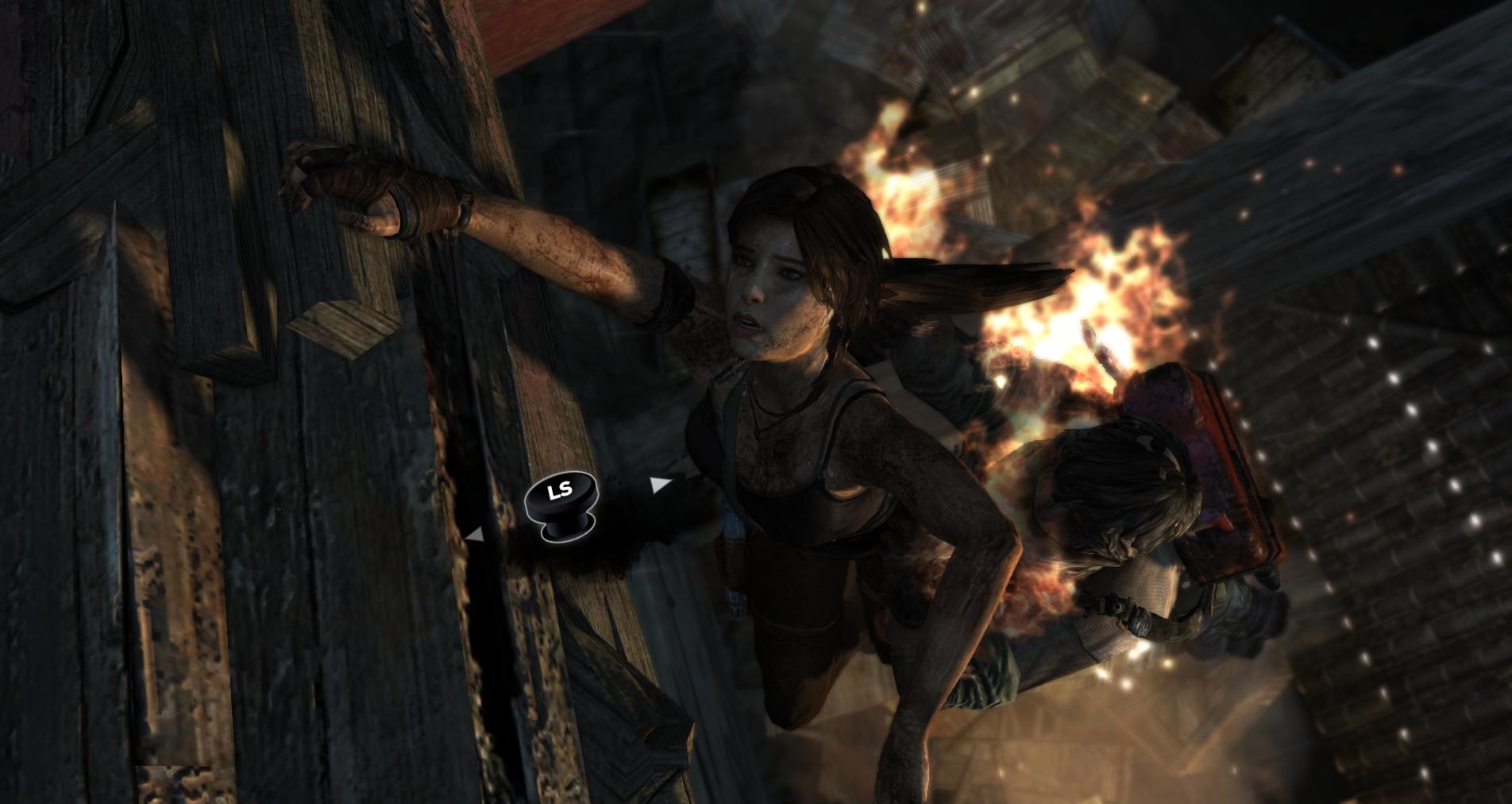
Failure scenes have become a separate art form. The new Tomb Raider sure has its share.

We've all had that one dream where something is attacking us and we can't do anything because it's a dream. In my case, I've dreamt that there's literally a snake in the grass in the front yard outside my house. I step into the grass, because it's a dream, the snake prowls around, lunges for me, end dream. I'm not particularly afraid of snakes, I guess I had recently watched or played something with snakes.

Then, one night, my dream changed. Same set-up, but this time when the snake lunged, time seemed to slow down and I saw a prompt for a dodge. The dream followed the prompt and allowed the snake to fall past me. The dream then prompted me to move in for a counter strike. I did, and, well, I can't really pull much more of the dream past that. Either way, waking up from that dream gave a very interesting feeling. My go-to dream for helplessness was completely turned around to be empowering. Because of video games? Because of quick time events?

Like I said before, quick time events are a reaction-based mechanic. They test your reflexes and hand-eye coordination by telling you a button to press and giving you little time to do so. Gamers typically have better association of buttons with functions than they do the labels of the buttons to their positions. I also mentioned how QTEs can be a gameplay translation of instinct. Instinct, which I define in simple terms as "being yourself quickly." That is, react as you would without taking time to revise in your head. It's empowering to know what to do and when. It helps you reaffirm your identity and proudly own it.

Heavy Rain, a PlayStation 3 title, was really ambitious with quick time events.

Video games always depict characters using instinct to save themselves or others from peril. In real life, ideally, peril is not ever-present. However, the opportunity to use our instincts is. For instance, I'm sure at some point in your life someone has approached you and said "hello." What did you do in return? Look at them and stare blankly while you decided between "hi," "hello," "good morning," or just a nod? Probably not. You picked a response and had a conversation. Your brain went through a little quick time event. Sure, nothing was at stake. Life would go on if you had said "apple," but all the same you were prompted and your instinct to greet the person back kicked in.

Saying "hello" isn't exactly the most intense example, but it is a relatable one. Real-life quick time events happen all the time. Some of them occurring in the form of decisions. Ever catch a ball that was flying straight toward you? Good job on that quick time event! Job seekers, have you ever seen a posting on craigslist that you qualify for but said "nah?" That was a quick time event that you willingly didn't respond to. The only difference is you won't come back to that moment to "get it right." This isn't guilt, just fact.

The fact that video game characters can respond to situations so quickly and expertly is why we see them as being strong. They don't second-guess what they're capable of, they just do what they can - or must. We too can be just like them. Sure, we won't be hitting any emergency brakes nor making jumps to safety, but we will be accomplishing commonplace feats that make us great people in our own home. Helping someone grab the milk on the high shelf, taking out the garbage, speaking up to volunteer, speaking up to not go through with something that you're being pressured into. All of these things which you may brush off or not feel "strong" enough to accomplish are more possible than you can imagine. It's not as simple as pushing a button, but it takes just as much effort when you set your mind to it.

Give it a try. See if, in your regular day, you can recognize a quick time event and do what you imagine it's prompting you to do. If you have any relatable experiences with real-life quick time events that you want to share, please post in any of the linked social media. I look forward to seeing responses. Until then, game out.

P.S.

I make quick time events out to be very promising, but in execution they actually have somewhat of a poor track record in gamer culture. See below for a humorous take.

Tuesday, March 12, 2013

Portal and Inception


Yes, that Inception. Get out your mammoth horns and spinning tops, because we've got to go deeper. Toss in thinking with portals, and we've got today's topic.

As any Internet cynic will tell you, the term "inception" actually has nothing to do with dreams, much less the act of entering one. In fact, the movie dedicates a whole scene to establishing the true definition of the word. Simply put, inception just refers to the point in which something begins. In the case of the film Inception, this thing is an idea. The goal of the movie is to change a person by planting an idea in their head by going into his dream. The inception of this personality change is the point in which he sees this planted idea.

Are you following me so far? If not, that's okay. All you need to know is that in the movie Inception, the characters manipulated a person by planting an idea in his head without him knowing. When this idea came to his attention, he felt like he came to this idea all on his own. As a result, the idea feels like his own and he has no instinct to resist it. He doesn't feel like he's being told what to do. As I watched this movie and heard these concepts explained, I wondered why this felt so familiar. Naturally, my answer ended up being the same old: video games.

In particular, I thought of Valve's mega-popular and memetic Portal. You see, the goal in a typical game is to present challenges to the player and lead them to overcome those challenges. Therefore, the inception of victory will occur while the game is being played. Portal is a great example because the very structure of the game is to undergo this process of challenge, discovery, execution, and victory over and over and over and over again. Really, I could use any game that involves puzzles or strategy. Portal is just easier to talk about and more well-known.

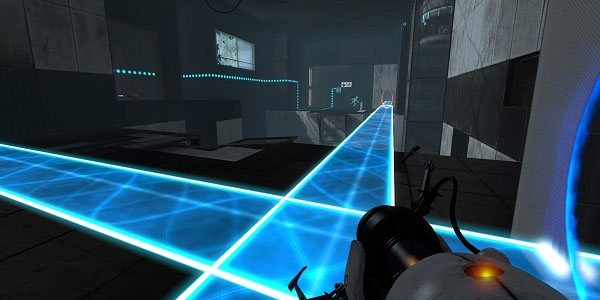
Your first experience with portals may be disorienting, but you'll get over it quickly.

In Portal, you play the role of a human "test subject" who must solve puzzles. The puzzles are solved when you manage to reach an elevator somewhere in a given room. This elevator is often placed out of reach and locked behind some door. You are armed only with  a portal gun and knowledge of how to use physics to your advantage. This portal gun literally shoots portals that you can set into walls, floor, and ceilings. You can only have two portals out at a time, colored orange and blue, and they only lead to each other. Thus, if you want to go somewhere far away, you can just shoot one portal ahead and one nearby. Walk through the nearby portal and you'll be wherever your further portal ended up.

This is all just the tip of the iceberg for Portal's complexity. However, it's enough information to pursue my topic. You can probably already see how Portal can be clever, even devious, with its puzzle designs. In any given puzzle, you already know all the information you need in order to solve it. Say, for instance, you need to place a block on a button in order to keep a door open. However, the block cannot reach the button. Then you may wonder: Since you can pass through portals, can you carry the block through with you? You can! You drop the block on the button and you're free to the elevator.

These moments of epiphany and triumph are common in Portal. You'll find yourself often saying, "Maybe I can... aha!" All it takes is for you to remember one little thing, try that little thing, and you come off with a great and revitalizing victory. Jane McGonigal refers to that feeling as a "fiero moment." "Fiero" is an Italian word loosely translating to "Pride." I suppose there's a cultural wiggle room there that allows us to define fiero also as a realization of one's own potential. The closest we have in the English language is the concept of not knowing one's own strength. But let's combine this with what we already talked about. You only came to this feeling because the game herded you to that victory by handing you everything you needed to succeed.

So, do we feel "played" by the game and its manipulation of our feelings? Or do we consider that our effort and problem-solving are still worth something? It doesn't help that the tests are overseen by a snarky AI who tries to mess with our head the entire way through. Well, it wouldn't be me if I didn't take the rosier approach. You still had to figure out your situation, you still had to make the most of your abilities, and you still had to execute the problem-solving. Sure, it's a video game, and problem-solving in a video game isn't exactly like real life, but that goes both ways. In real life, you might end up not prepared enough to solve a puzzle. On the other hand, a problem in real life might have several solutions, some of which easier and better for all involved. And to be honest, I'd rather feel prepared and wrong than in over my head and wrong. For all we know, "being prepared" can translate to one's ability to improvise. And you will be shocked at how well anyone can improvise.

The sequel adds even more complexity to the mix.

Now I'll turn it over to all of you. What stories do you have of great success and realization of your potential? This applies for in games and off. Successes outside of games, more importantly. If a success in a game can remind you of a success in real life, well, chalk that up as a game learning experience.

I really do hope that this discussion can help you rediscover something awesome about yourself. There needs to be more awesomeness going around the world. And if it does so happen that this post leads to some great revelation, you can thank inception for that. If you can't tell, I want to make the world a better place, one person at a time, starting with fans of games. If and when I accomplish this positive change, the inception of that change will be you reading these posts and being prompted to think on them. I've probably harmed my chances by admitting to it, but it's all for the sake of another point.

"Performing inception" is a real thing. It might not be as direct as in the film, but it happens any time anyone tries to be persuasive. The key is to be discreet, agreeable, and not have the other party feel like they're being told what to do. Think of one standout time that a game performed inception on you. Further, one time you may have performed inception on someone else. It's more common than you think.

I do apologize for the brevity of this particular post. I really did intend on just talking about Portal and Inception. My mind just goes wherever a deeper topic may present itself. In this case, talking about fiero moments. Look on the bright side, you got two posts today.

A discussion within a discussion.

Monday, March 4, 2013

Super Mario 3D Land and Taking off the Training Wheels


I love the heck out of Super Mario 3D Land for the Nintendo 3DS. One of my friends, however, begs to differ. In a conversation some time back, she says that the game focused too much on one of its features and came out weaker because of it.

The feature in question is the game's "Tanooki Suit" power-up. Simply put, the Tanooki Suit's main function allows Mario to hover in air and generally be much more maneuverable when jumping. Since jumping between platforms is the backbone of the game, having this power-up clearly makes things tons easier.

After that conversation, I knew what I had to do. I created a new file in Super Mario 3D Land and set out to play through the game with one stipulation: Never use the Tanooki Suit. This way I can compare the impact of suit versus no suit.

My friends, this game is amazing when you don't use the Tanooki Suit. The stages are tougher to navigate, more careful jumping is necessary, and you even get to explore more of what the game has to offer.

First and most obvious, the game was more difficult. If I missed a jump over a pit, I couldn't just scramble my way back to try again. It was down into the pit with me. If my jump landed me in front of an enemy, that was my problem to deal with. And I loved it. It was practically a whole new game now that all the circumstances had been changed.  I adjusted my play style to account for a lack of a "get out of trouble free" card and was happily on my way.

Secondly, I came to appreciate the game's other power-ups. Despite the game emphasizing the Tanooki Suit so hard, it contained two other power-ups: the fire flower and the boomerang flower. These power-ups give Mario the ability to launch fireballs or use boomerangs to damage enemies. Boomerangs can even collect coins wherever it goes. However, these items offer no mobility upgrades, so they were booby prizes compared to the Tanooki Suit. In fact, I distinctly remember in my first play through going out of my way to avoid these power-ups. I only used the Tanooki Suit with another one in reserve.

See the shadow, the goomba, the tail in the title? It's everywhere, man.

Now that the "default" power-up was no longer in the picture, I was free to make use of the other two. This also added to the fun factor since I had more choices in how to defeat enemies. I could just clear the path from afar, pull some impressive shots by bouncing the fireballs off of walls, or safely defeat bosses by having my projectiles to the work. I could even carry the other item in reserve just in case I wanted to switch up the play style. I also got less upset when I took a hit and lost the power-up. I still had my core abilities and the way I moved stayed the same. In some cases, I would value the extra hit over the actual abilities of the power-up.

Thirdly, there is just more fun to be had when the game isn't too easy. I was amazed at how the game engaged me. Before, I could just float through - in some ways literally - without much challenge breaking my stride. Now I just had my skill, wits, and reaction time; all of which improved to adjust. For instance, I had to jump from a rotating block to reach a collectible item. The window for making this jump was tiny. I had to wait for the platform to rotate into the optimal position and still jump at the very furthest I could to get the most height and distance. I must had stayed at that point for at least half an hour straight, jumping, falling, coming up short, and having to traverse the whole stage again just for another shot. Finally, one particularly focused jump saw Mario perch himself on top of the flag pole. I earned a 1-up and a golden flag. I thought I had passed out and was dreaming. It probably was the most rewarding thing I had done in a video game in a long time.

If I were using the Tanooki Suit, I could have made the jump with a half-hearted effort on the first try. There also is an alternate way to make the jump much easier, but that would have had to wait way later in the game.

At this point, this post probably closely resembles the previous one, trumpeting the praises of the self-imposed challenge. And that is true that it's similar. In this case, rather than add more challenge to build a new skill, we are instead avoiding the path of least resistance to enrich the experience. I'd instead say that the game was built around Mario's default jumping abilities. Using the Tanooki Suit is more akin to an "easy mode" than the default.

I can now see where my friend's frustration comes in. The game wasn't necessarily middling to easy, it actually is pretty well crafted. However, it came bundled with Nintendo's PR move to put the Tanooki Suit front and center for the throwback effect. If only there were an Options menu button that could remove the Tanooki suit, or some method of bringing to peoples' attentions the possibility of playing the game in such a way. I count one single collectible that absolutely required the Tanooki suit to obtain. Otherwise, you could play through the game, as-is, and complete every objective. To prove my point, here's someone beating the game's toughest level without use of the Tanooki Suit.


This whole thing got me thinking on how we use inhibitors in our everyday life to make things more comfortable. These range from physical assistance such as escalators to mental and emotional processes that lead us away from the strain of thinking for ourselves. Go ahead. Try and find at least one thing you "use" in your life that makes it easier but duller. Do you think you could carry on without that thing for a little bit? I'd like to see you try. Others would probably like to see you try. Most importantly, I'd wager that you would like to see you try.